
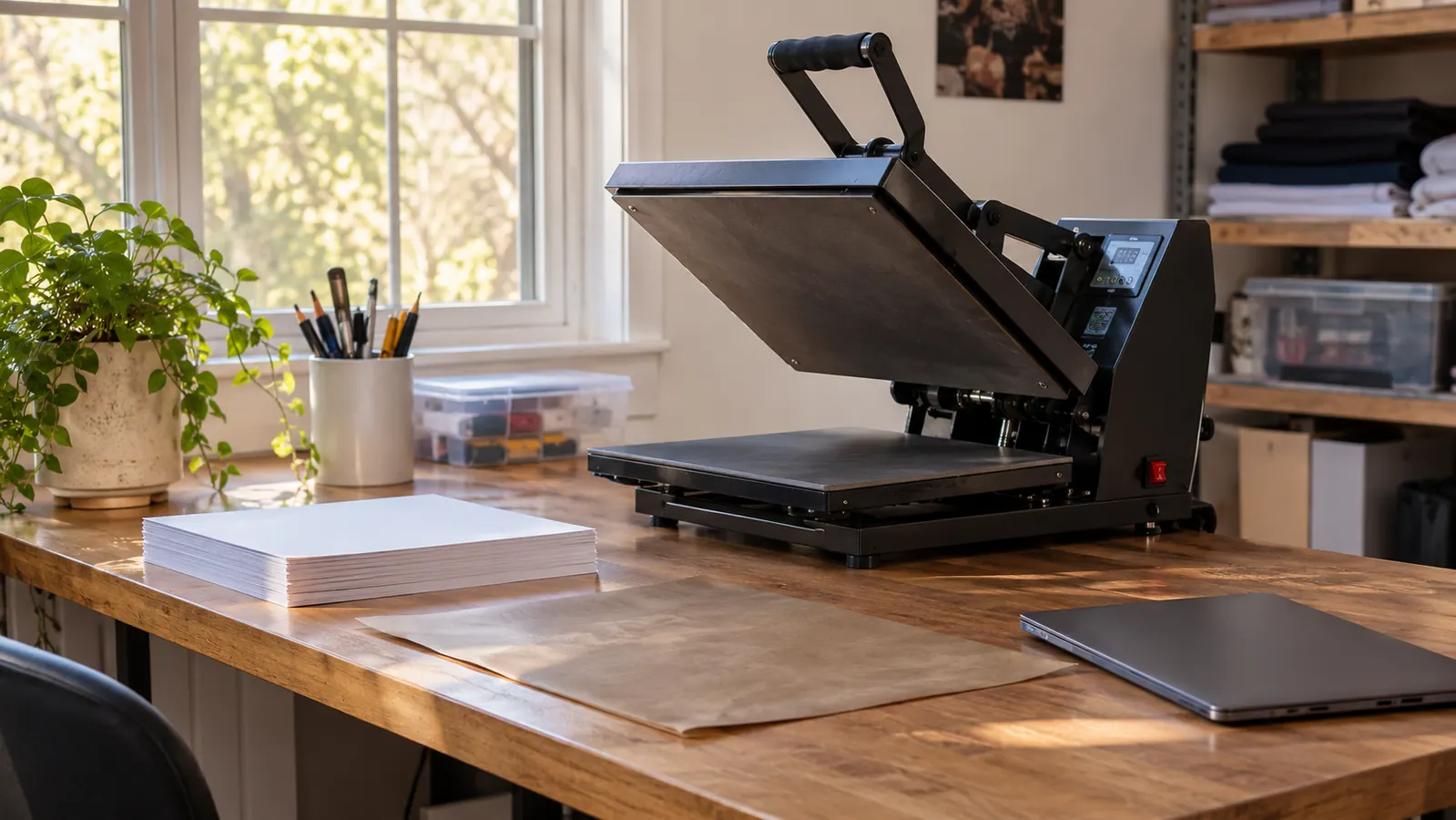
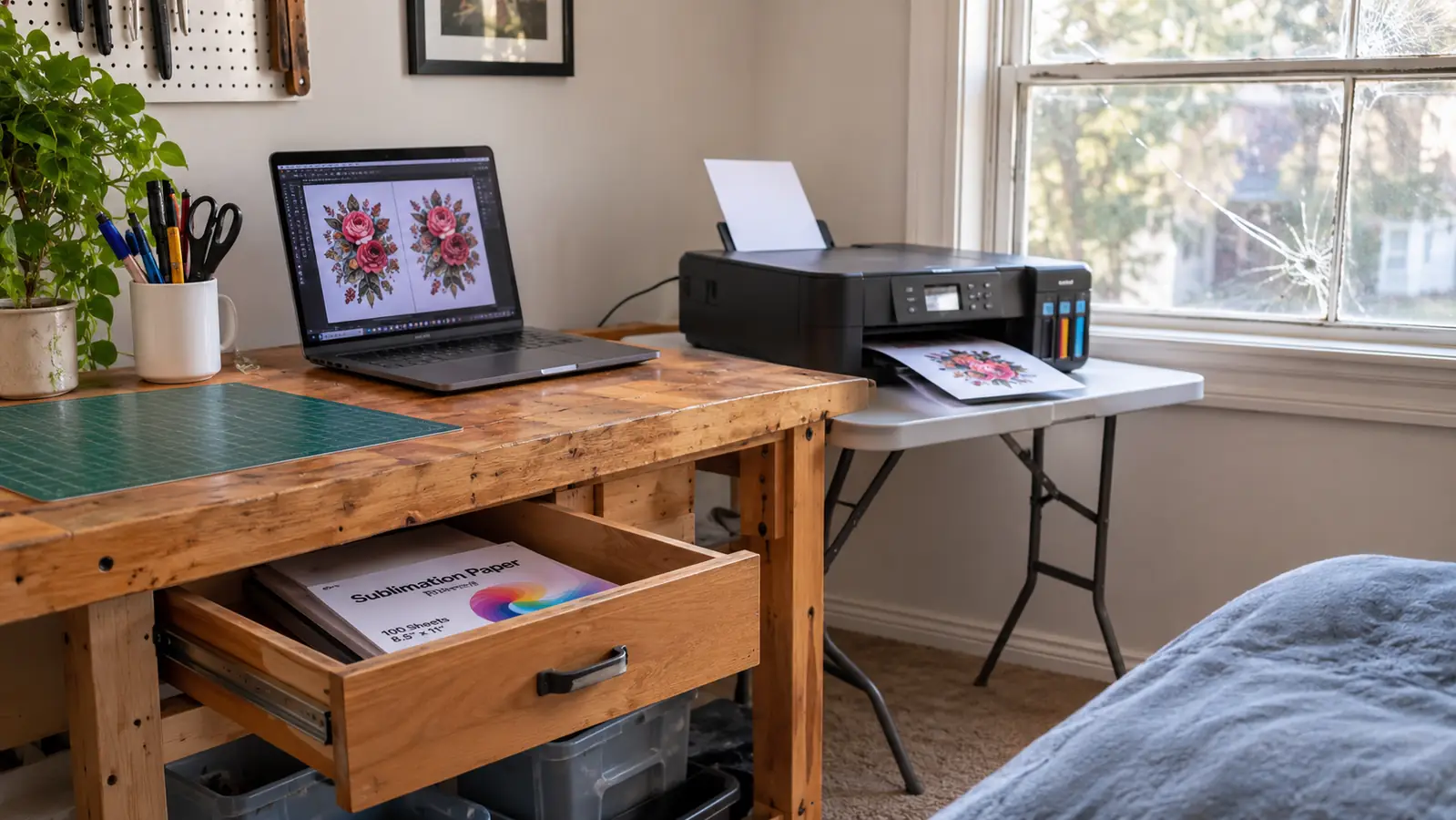
I have a pack of A-SUB Sublimation Paper in the drawer under my printer as I write this. It has been there since the first week of May, when I bought the Epson F170, the A-SUB paper, and the HTVRONT tumbler press together with my own money. Pam, my craft fair friend, uses HTVRONT sublimation paper at her bench in the garage. I have printed every sublimation job of my own on A-SUB. I have tried Pam's paper a few times at her place, and that is the only experience I have with it. So this is not a lab test. It is one woman in a spare bedroom in Evansville, Indiana, with a 15x15 press and a printer that only feeds 8.5x11 sheets.
Short answer: for my setup, A-SUB is the paper I keep using. The 110-sheet pack fits the way I work, the coated side has been consistent, and I have not had a feed jam since May. HTVRONT is not a bad paper. Pam gets clean transfers with it, and if you already have a pack that behaves in your room, I would not tell you to switch just to match me. The rest of this is where each one actually won at my bench or hers.
| A-SUB Sublimation Paper | HTVRONT Sublimation Paper | |
|---|---|---|
| Pack count | 110 sheets per pack | Sold in a pack; Pam keeps hers in a clear bin |
| Printer fit | Runs in my Epson F170 at 8.5x11 | Runs in Pam's sublimation printer |
| Paper weight | 125 g item weight, listing says 120 paper weight | Feels close in the hand at Pam's bench |
| Finish | Coated, high transfer rate on the listing | Clean releases at Pam's bench |
| Print side | Easy to mix up, so I check each sheet | Pam marks PRINT on her wrapper |
| Humidity and curl | Curled at the edges in my humid spare bedroom, so I store it flat | Stayed flat on Pam's shelf in the garage |
| Blanks listed | Polyester, cotton content 30% or less, ceramic, tile, phone case, metal | Polyester shirts and tumblers at Pam's bench |
| Warranty | No paper warranty | No paper warranty |
| My routine | 385 F for 50 seconds on shirts, 365 F for 150 seconds on tumblers | Pam's own timing at her auto press |
| Best for | My spare bedroom and letter-size printer | Pam's garage and her workflow |
Where A-SUB Wins
A-SUB wins on the count in the pack. One pack is 110 sheets at 8.5x11. That sounds small until you are the one buying paper. I know exactly what I have, I know when I am getting low, and I know the next pack will be the same size and the same weight. The listing gives the item weight as 125 g and the paper weight as 120, and the sheet is coated. I am not a paper scientist, but I can tell you the stack feels the same from the first sheet to the last. It is also the paper I know. I started sublimation in mid February with a converted EcoTank and generic no-name paper. That paper is gone. A-SUB came in May with the F170, and it has been the only sublimation paper through that printer since. When I had the bad Saturday in late April with the blurry tumblers and the clogged EcoTank, the paper was not the thing I trusted. After I switched, the tumblers I remade came out sharp, and I have not had a reason to question the paper since.
The second win is that A-SUB stays in its lane. The listing says it works only with sublimation ink, on white or light polyester, on material with cotton content of 30% or less, and on coated blanks. That matches the jobs I actually take. I do not make mugs, hats, ceramic tile, or phone cases, so I cannot vouch for those lines on the listing. I make polyester shirts and 20 oz straight tumblers. A paper that is honest about its lane is easier for me to trust than one that claims everything.
Where HTVRONT Wins
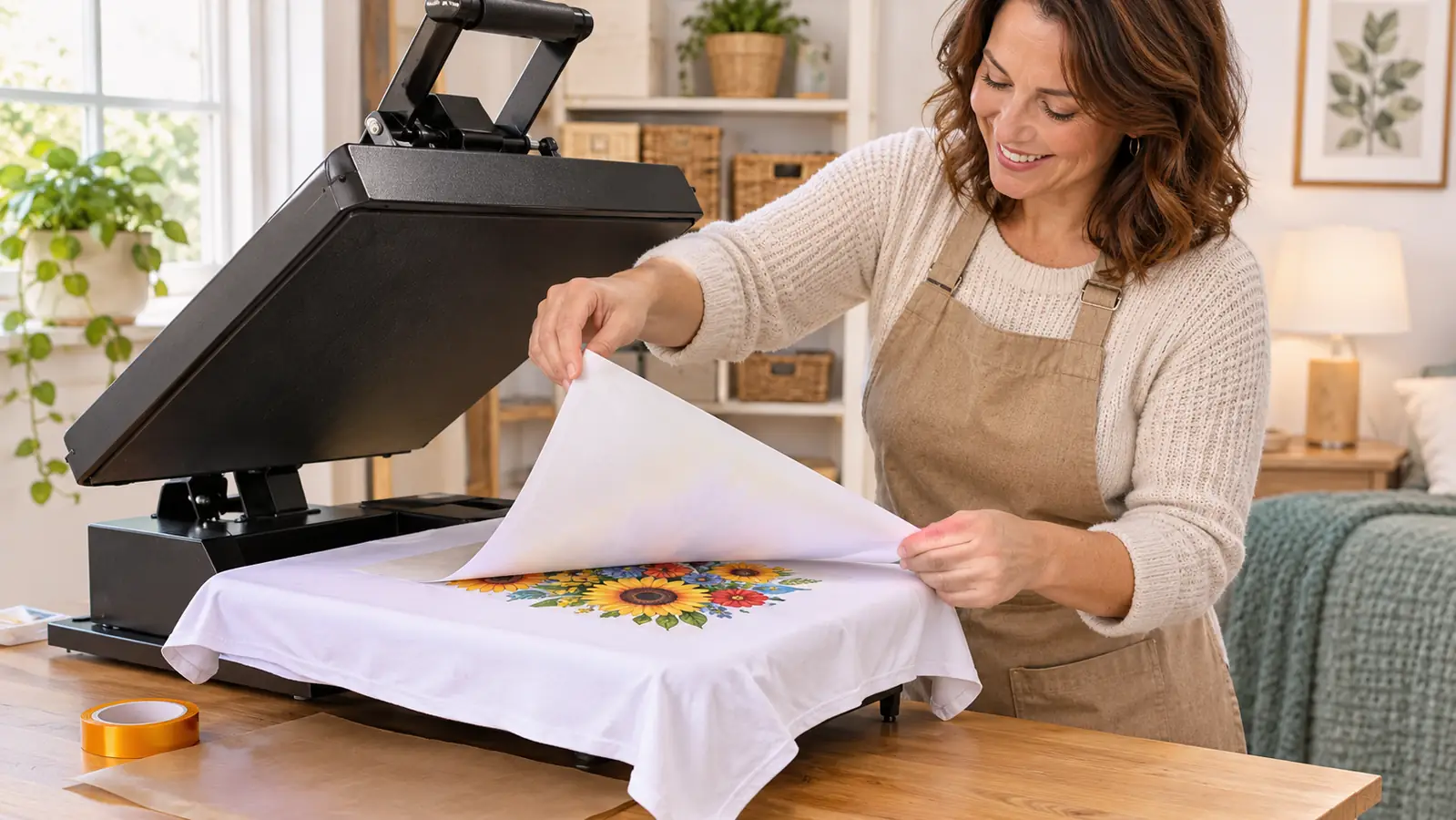
HTVRONT wins on flatness in Pam's garage. My spare bedroom gets humid, especially with the window cracked while the press is running. My A-SUB sheets curl at the edges if I leave the pack open, so I keep it flat in a drawer and close the bag. Pam's HTVRONT sheets sat flat on her shelf. That is a real difference I saw with my own eyes, though I cannot tell you whether it is the paper or the room. If your work area is damp, that is worth knowing.
HTVRONT also wins if you already have it dialed in. Pam knows her press, her paper, and her timing. She can hand me a shirt she made with it and the transfer is clean. I am not going to tell her to throw out a paper that works at her bench just because I like mine. A paper that is already behaving in your room beats a paper that is only better on someone else's bench. That is not a knock on A-SUB. It is just the truth about supplies.
The Paper I Keep Flat in the Drawer
A-SUB has run every sublimation print of mine since the first week of May, on polyester shirts and 20 oz straight tumblers. One pack is 110 sheets at 8.5x11. If your printer feeds letter-size sheets, this is the paper I would start with.
Amazon Get the 110-Sheet Pack on Amazon →How I Compared Them
I did not run a head-to-head test with a stopwatch and a clipboard. I compared the paper I use every week with the paper Pam uses at her garage. My side of the comparison is A-SUB, bought in May, kept flat in a drawer, run through the Epson F170. Pam's side is HTVRONT, which she has at her bench and has used longer than I have used mine. I asked her the same questions I ask myself: does it feed clean, does the print side confuse you, does it curl, and do the transfers come out sharp on a polyester shirt or a 20 oz tumbler.
The limits are worth saying out loud. I have never bought a pack of HTVRONT paper, so I cannot tell you how it behaves over six months in my house. Pam has never run A-SUB through her printer. Our rooms are different, our printers are different, and our hands are different. What I can tell you is what happened at each bench. That is more useful to me than a spec sheet anyway, because paper is one of those supplies that either feeds or it does not.
The one thing I can compare without guesswork is my own routine. I print on A-SUB at 385 F for 50 seconds on polyester shirts, and at 365 F for 150 seconds on 20 oz straight tumblers in the HTVRONT tumbler press. I mirror every design before printing. I use a teflon sheet or butcher paper, heat tape, and gloves. None of that changes from paper to paper, which means when something goes wrong, the paper is the first thing I look at.
The Print Side Problem
The print side is the thing I would warn a beginner about with either paper. A-SUB has a coated side and a plain side. If you print on the wrong one, the transfer is faint or patchy, and you will blame the paper, the press, or the ink. I check the sheet by feel and by the slight difference in the surface before it goes into the F170. I do not trust memory. It is too easy to grab the wrong face when you are moving fast on a Saturday.
Pam's HTVRONT paper has the same kind of issue. She writes PRINT on the wrapper of her pack so she can see it from across the bench. That is not a product feature. It is a work habit. It is also the kind of thing that separates a clean transfer from a wasted sheet. If you take one thing from this comparison, take that: mark your pack, keep it flat, and check the face before you print.
I also keep the A-SUB pack in a drawer, not on the open table. The spare bedroom is small, and the window is open when the press is on. Paper picks up moisture. A curled sheet can feed crooked or sit wrong on the platen. I learned that in the first month. Now the pack stays flat, the bag stays closed, and I pull one sheet at a time. It is a small habit that saves a sheet and a shirt.
What the A-SUB Paper Is Actually Listed For
The A-SUB listing says it is for white or light colored high quality polyester, material with cotton content of 30% or less, premium ceramic and tile, phone cases, and metal. It also says it only works with sublimation ink, and that regular ink does not work. I can confirm the sublimation ink part because my F170 runs sublimation ink and nothing else. I cannot confirm the ceramic, tile, phone case, or metal part because I do not make those items. I am not going to pretend I do.
What I can confirm is the size and count. The sheets are 8.5x11, 110 to a pack, and the listing gives the item weight as 125 g and the paper weight as 120. The finish is coated, the brightness is listed at 80 lm, and the material feature is high transfer rate. Those are the numbers I can point to. The rest is my experience: it feeds through the F170, it releases from the platen with the shirt or tumbler, and the color comes out where I put it.
What Pam's HTVRONT Paper Does at Her Bench
Pam's HTVRONT paper is part of her whole HTVRONT setup. She has the HTVRONT Auto Heat Press, and she has an HTVRONT HTV roll for cotton shirts. She does not use A-SUB. When I am at her garage, I watch her pull a sheet, check the face, and lay it on the shirt. The transfer comes out clean. I have not seen her fight a jam or a curl the way I fight the humidity in my spare bedroom.
I have not bought HTVRONT paper, and I am not going to write a review of a product I have only used a few times at a friend's bench. What I can say is that it works in her room. It fits her printer, her press, and her routine. If you are starting from zero and you have a friend who uses HTVRONT and will show you the ropes, there is nothing wrong with starting where the help is.
One pack is 110 sheets, and I have not had a feed jam since May.
The Jobs I Actually Run
My jobs are not complicated. I make polyester shirts for coworkers, neighbors, and my church. I make 20 oz straight sublimation tumblers. I do not make mugs, hats, rhinestones, ceramic tile, or phone cases. I do not have a mug press. I do not have a sublimation oven. I have a 15x15 clamshell press that Gary built a bench for, a tumbler press on a folding table by the window, and an Epson F170 that prints 8.5x11 sheets.
For that work, A-SUB is enough. I print the design mirrored, press the shirt at 385 F for 50 seconds, and press the tumbler at 365 F for 150 seconds. The paper has to do one thing: carry the ink and release it clean. It has done that since May. I am not asking it to wrap a tapered tumbler or handle a ceramic tile. I am asking it to be the same sheet every time I open the drawer.
Pam's work is a little different because her tools are different. She has the auto press and the HTVRONT paper. She can run a shirt while I am still taping mine. That does not make her paper better for my bench. It makes her setup better for her. This is the part where beginners get lost. They buy the paper someone else uses and expect the same result in a different room with a different press.
Where the Two Papers Feel the Same
In the hand, the two papers feel close. I am not going to claim one is dramatically thicker or smoother, because I have not measured them side by side with a gauge. Pam's sheet and my A-SUB sheet both feel like coated sublimation paper. Both need the correct face up. Both need to stay flat. Both need sublimation ink. If you close your eyes and handle them, you would not be able to tell me which is which.
They also both punish the same mistakes. A wrong side, a wet sheet, a design that was not mirrored, a press that is off temperature. None of that is a paper problem, but the paper gets blamed. I check my press with a cheap infrared thermometer because the display can be off. I check the sheet before it goes in. I keep the pack flat. Those three habits matter more than the name on the wrapper.
Who Should Buy Which
Buy A-SUB if your printer is a letter-size sublimation printer, if you print polyester shirts and straight tumblers, and if you want a 110-sheet pack that you can keep flat in a drawer. Buy it if you are like me and you would rather learn one paper well than keep switching. It is also the one I would hand to a beginner who has an Epson F170 or another 8.5x11 sublimation printer and no local friend to coach them.
Buy HTVRONT if you already use it, if your work area is drier than my spare bedroom, or if you have a friend like Pam who can show you her setup. Do not buy it because someone on the internet said it is the only paper. Do not buy A-SUB for the same reason. The paper is one part of a chain that includes your printer, your press, your ink, your blank, and your room. The best paper is the one that feeds clean and releases clean in your space.
Start With the Paper That Fits Your Bench
If you print 8.5x11 and you want one less variable to chase, A-SUB is the paper I have used since May. Keep the pack flat, check the coated side, and give the transfer a clean release.
Amazon See the A-SUB Paper on Amazon →