
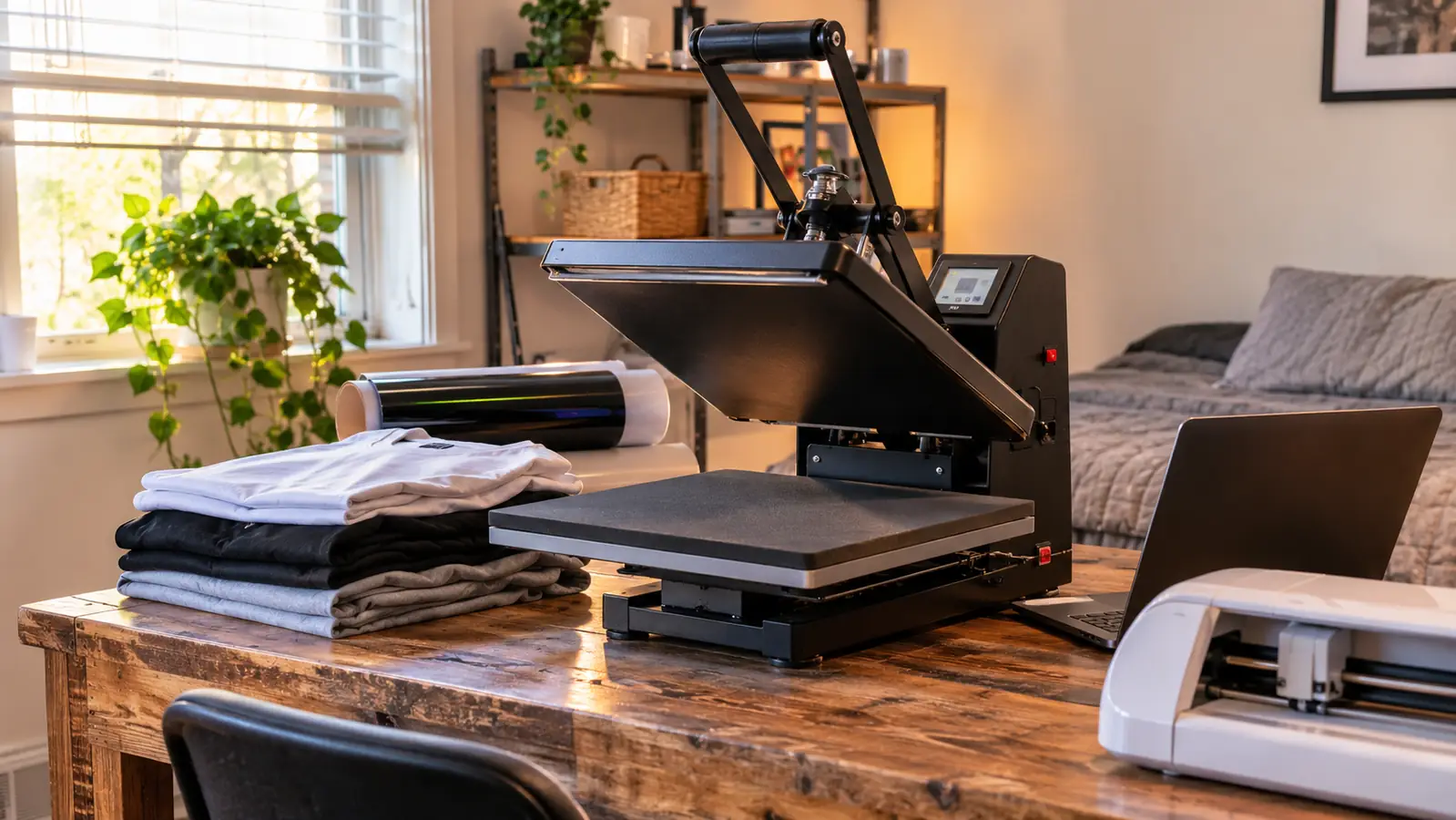
In December I made twelve Christmas shirts with my Cricut and the iron that lives in the hall closet. They looked fine on the kitchen table. Then two of them went through the wash and the vinyl lifted at the corners like old tape, and I stood in the laundry room holding a shirt I could not give to anybody. That is how I ended up buying a Fancierstudio 15x15 heat press in the first week of February, with my own money, from Amazon, in the same order as a roll of Siser EasyWeed. Nine months later it still sits on the workbench my husband Gary built in the spare bedroom, and it has pressed a lot of shirts. Coworkers at the dental office, a few neighbors, our church, and a stack for one fall craft fair.
I answer phones at a dental office on weekdays. I press shirts on weeknight evenings and Saturdays, in one spare bedroom, with one Windows laptop and the Cricut I already owned for greeting cards. So this is not a spec sheet read out loud. It is what nine months of real use looks like on one machine: what I press, what I had to work around, and the handful of things I would tell a friend to check before she plugs one in.
The Quick Verdict
A plain, heavy, honest workhorse that presses flat shirts well and does not ask you to learn anything. The Fancierstudio gives you a full 15x15 platen and a real digital controller for a lot less than the machines that open themselves. The three month warranty and the temperature display are the trade.
Amazon Check Today's Price →Nine months in, I would hand over my own money for this press again
It is the one piece of equipment on my bench that has never once made me redo a job. Check today's price on Amazon and skim the recent reviews before you commit, since the listing has been up for years and the newer ones tell you how the current batch is arriving.
Amazon Check Today's Price on Amazon →How I've Used It
The press lives in one spot, because it does not travel. It sits on Gary's workbench under the window, plugged into an outlet that has nothing else running on it. The listing says 1800 watts at 110 volts, and that is a real draw from one wall circuit. In the first week I had it sharing with the lamp and the little radio in that room, and the breaker made its opinion known. Since then everything else on that outlet stays off while the press is heating.
A Saturday looks like this. I switch the press on before I do anything else so it can climb to temperature while I cut vinyl or trim a sublimation print that came off the printer. Then I press in batches, because waiting on the platen is the slow part of the whole job, and it is much slower if you switch the machine off between shirts. The Fancierstudio holds its heat well enough through a long morning that I stopped checking the display between presses and only check the platen at the start.
What it does not do is tumblers. A flat platen cannot wrap a round 20 oz straight tumbler, so I have never pressed one on it. Tumblers go in the tumbler press. Everything flat comes here. That split keeps my Saturdays short.
What a 15x15 Platen Actually Gets You
Fifteen inches by fifteen inches is bigger than it looks in a listing photo. A full adult front print fits with room to spare. A back print fits. What I did not expect is how much it changes the way you load a shirt. The entire front panel sits flat at once, so a large design is one press instead of two passes with a seam in the middle that you have to line up by eye and hope.
The teflon coating on the platen earns the mention it gets in the product description. Vinyl leaves a faint ghost on a bare platen after it is peeled, and that ghost starts printing itself faintly onto the next shirt. I wipe mine down with a dry cloth every few sessions and that has been the whole of my maintenance routine for nine months. It is a thirty second habit and it is the reason my white vinyl still looks white.
The controller is digital. You set a temperature and you set a time in plain numbers, and the listing gives the timer range as 0 to 999 seconds with a temperature control that accepts settings up to 699 degrees F. I have never gone near the top of that. Two settings cover everything I make, and they are written on a sticky note stuck to the side of the machine so I do not have to think about anything at nine o'clock at night.
The Two Numbers I Set Every Time
For cotton and vinyl, I set 305 degrees F and 15 seconds, and I peel hot. That is Siser EasyWeed, and it behaves the same on a light shirt as it does on a dark one, which is the whole reason vinyl exists in my workflow at all. Sublimation will not go onto cotton, so every dark or cotton shirt in this house is a vinyl shirt, cut on the Cricut and pressed right here.
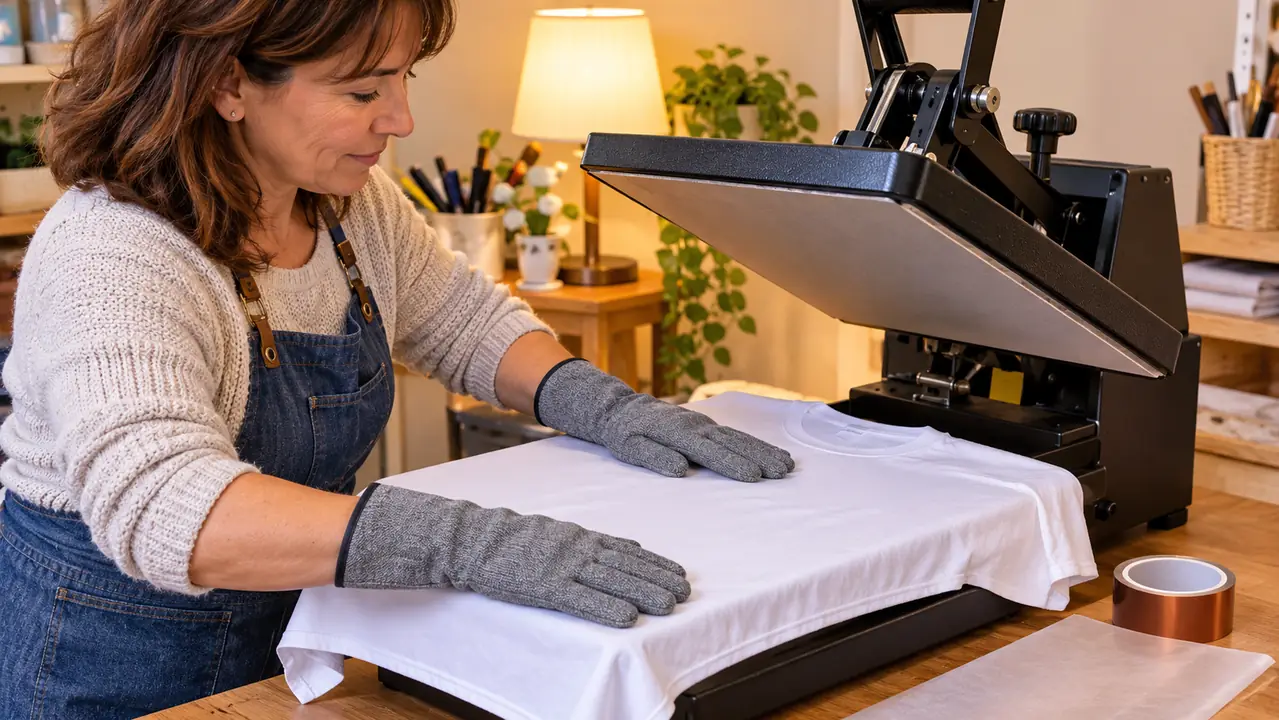
For sublimation, I set 385 degrees F and 50 seconds, on white or light polyester only. The print goes face down on the shirt with heat tape at the corners so it cannot shift when the platen comes down. Butcher paper or a teflon sheet goes over the top to keep ink off the platen. Gloves on, peel the paper while it is still warm, and let the shirt cool flat before you fold it, because folding a warm sublimation print can leave a crease you will see in the morning.
Those two numbers, plus remembering that the lower platen needs to be warm, are the whole of what goes wrong for beginners in my experience. If the shirt shifts, the design goes blurry. If there is no cover sheet, the platen picks up ink and passes it along to the next job. If the paper is not taped, the corners curl and you get a double edge. None of that is the press being bad. All of it is the press being a hot flat surface that does exactly what you tell it.
A heat press is not clever. It is hot and it is flat, and every good result I have had came from getting the shirt flat and the number right.
The Display Runs a Little Warm, So I Check It Myself
The display tells you what the controller believes the platen is at. That is not the same thing as what the platen actually is, especially in the first ten minutes after you switch the machine on. I learned that the way most people learn it, by pressing a shirt before the press was really ready and watching one corner of vinyl refuse to stick while the rest of the design bonded just fine.
So I bought a cheap infrared thermometer, the kind you point at a skillet to check a pan. Now I hit the platen with it before the first press of the day. If the display says 305 and the gun says 280, I wait. That one habit fixed nearly every early failure I had, and it cost me less than a pizza. It is not a defect exactly. It is what a controller on a press at this level does, and a two second check covers it.
The other habit is letting it come up to heat with the platens closed for a few minutes. The upper platen heats, the lower one warms through contact, and pressing onto a cold lower platen is how you get a design that sticks on the top half and lifts on the bottom. That is why a quick pre-press comes first, every time.
What Bothers Me After Nine Months
The warranty is three months. I read that when I bought it and told myself it was fine, and it has been fine, but three months is short for a machine this heavy that gets used the way mine gets used. Nothing has failed in nine months. The handle still pulls square, the timer still counts down, the platen still heats evenly from corner to corner. But if something had gone in month four, I would have been on my own with it and a phone number.
It is heavy and it does not want to move. The listing gives the dimensions as 33 inches long, 23 inches wide, and 20 inches tall, and that is a footprint that eats a whole workbench. Mine has not moved since February and I like it that way. If you are in an apartment and the press has to come out of a closet and go back in, think hard about that, because lifting it up and down every week is not something I would sign up for.
It opens up and toward your hands. The clamshell swings the hot upper platen up and leaves it sitting there at about chest height while you load and unload the lower one. Nobody warned me about that part. I wear gloves every single time and I still count this as the step where I am most likely to get hurt. That is not the Fancierstudio misbehaving, it is just the shape of a clamshell, but it is worth knowing before your first Saturday.
One more, and it is small. There is nothing on the front of the machine that tells you it is still hot after the timer finishes, and it stays hot for a long while. I lay a folded towel over the lower platen when I am done and leave it there for half an hour. If anyone else in your house wanders into the craft room, teach them that the press is hot long after it looks idle and quiet.
What I Liked
- Full 15x15 pressing area takes a large back print in one pass, no seam to line up
- Digital temperature and timer set in plain numbers instead of a dial you guess at
- Teflon coated platen wipes clean in seconds and keeps white vinyl white
- Holds heat steadily through a long Saturday of batch pressing
- Simple enough that I stopped needing the manual after the first week
- Nothing on it has failed, loosened, or needed adjusting in nine months
Where It Falls Short
- Three month warranty is short, and I felt that once month four arrived
- Display reads warmer or cooler than the platen, so I verify with a thermometer
- Big footprint at 33 by 23 by 20 inches, and heavy enough that it stays put
- Clamshell opens toward your hands, so gloves are not optional
- 1800 watts wants an outlet with nothing else running on it
Where It Fits Next to an Auto Press
My friend Pam has the HTVRONT Auto Heat Press on a bench in her garage, and I have used it a few times at her place. It opens itself, which is genuinely nice, and it takes most of the fear out of loading a shirt with the hot platen hanging over your knuckles. It is the more expensive of the two, and it takes up roughly the same bench space. What I noticed is that the auto opening did not make her shirts any better than mine. It made her less nervous. That is worth something real, but it is not the same as better.
For a beginner pressing flat things in a spare bedroom, the manual clamshell has one advantage that has nothing to do with money. You feel the press through the handle. You learn what a shirt needs because your arms tell you when the lower platen is not sitting flat. I would not trade that for auto opening yet, though I will admit I say that from a bench that already has one press bolted to it.
Who This Is For
If you are pressing flat shirts, totes, or mouse pads in a spare room, and you want one machine that will still be working when you have figured out whether you actually like doing this, this is a sensible place to start. Beginners do not need auto opening. They need a platen that is hot, a timer that is honest, and a machine that does not shift when you pull the handle. The 15x15 size means you are not shopping again in eight months because a back print does not fit on the small one.
Who Should Skip It
Skip it if you need to press tumblers, mugs, hats, or anything that is not flat, because it will not do those and no amount of determination will change that. Skip it if the press has to live in a closet between sessions. Skip it if a three month warranty is a dealbreaker for you, which is a fair position to take with a machine that gets this hot. And skip it if you are pressing all day every day, because there are machines built for that kind of volume and this one is built for someone like me.
The press I stopped thinking about, which is the highest compliment I can give a tool
Nine months, one bench, and no job I had to redo. If flat shirts are what you press, start here and spend your worry on the printer instead. Today's price is on the listing, and the current reviews will tell you how the latest batch is arriving.
Amazon Check Today's Price on Amazon →