
There is a point about six tumblers into a bridal party order when you find out whether your tumbler press is a tool or a toy. Mine came on a Saturday in late April: a countertop toaster oven, a pack of shrink wrap sleeves, a heat gun, and a friend's name on the order. The tumblers came out streaked and soft at the edges, and the converted printer clogged the same afternoon. I boxed the whole setup up, unplugged the oven, and sat on the floor of the spare bedroom for a while with my back against the workbench Gary built.
A week later I ordered the HTVRONT Auto Tumbler Heat Press, a real sublimation printer, and paper that came recommended, all with my own money. That was the first week of May. I have used the press most weeknights and most Saturdays since, always on 20 oz straight tumblers at 365 F for 150 seconds, and I have made enough mistakes on it to tell you the parts the product page skips. This is not a love letter. It is the review I wish somebody had handed me in April, standing in my driveway with a box under each arm.
The Quick Verdict
A one at a time tumbler press that takes the guesswork out of clamping and hands the clock back to you. Six months in, it is the only thing I press drinkware on.
Amazon Check Today's Price →Six months in, this is the only thing I press tumblers on
It does one cup at a time and it makes you time it yourself. It also turned a job I dreaded into a job I can do while the kettle boils. Check the size range against your blanks, then look at today's price.
Amazon Check Today's Price on Amazon →How I Have Used It
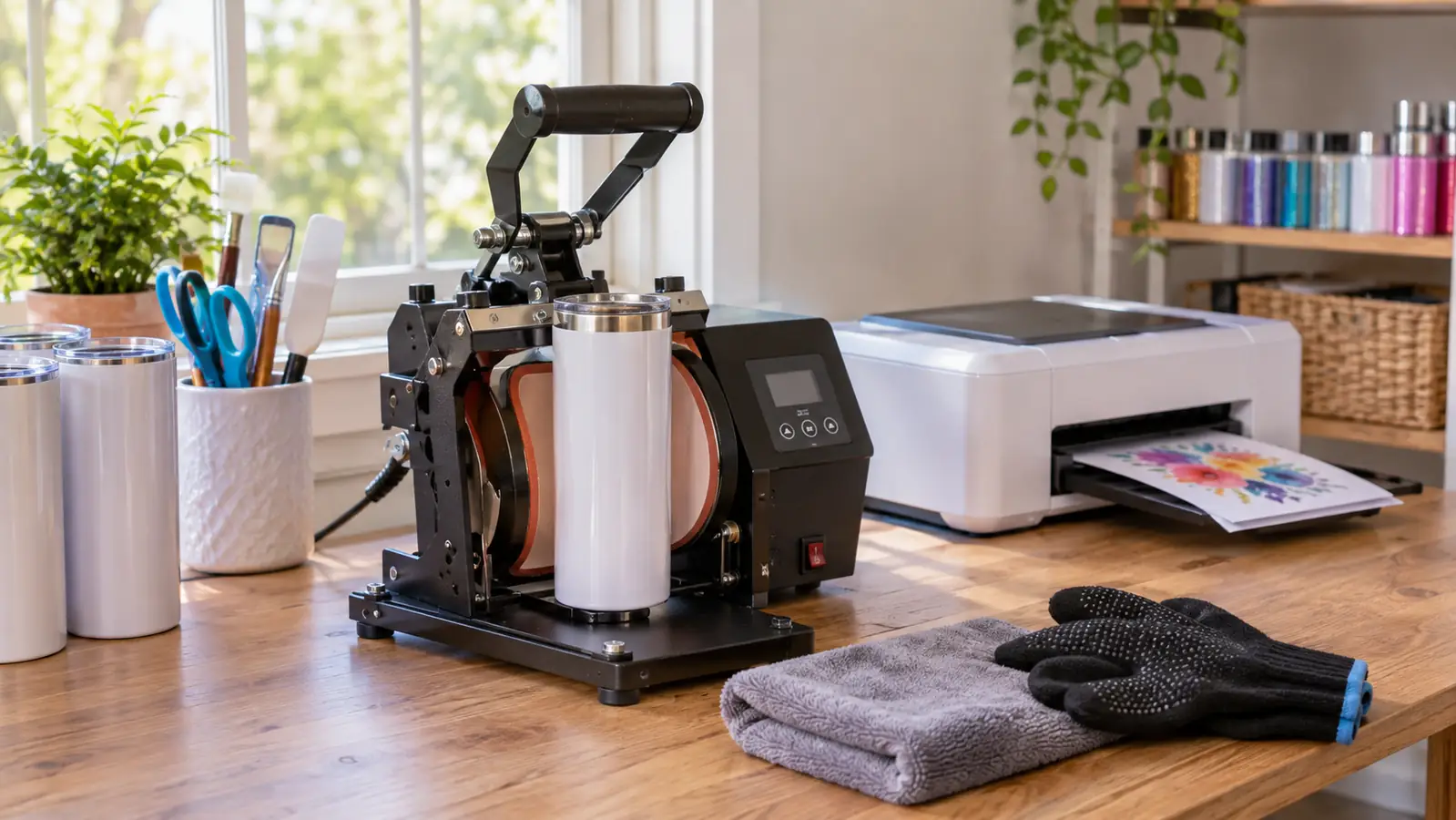
My setup is one spare bedroom, a workbench Gary built, and a folding table by the window. The flat press lives on the bench. The HTVRONT press and the printer share the folding table, and I crack the window while both are running. The table is deep enough for the printer at the back, the press at the front, a folded towel squared off at the right edge, and the heat gloves stacked on the towel. That is the whole shop. I am not a printer and I am not a shop owner. I answer phones at a dental office on weekdays and press on weeknights and Saturdays.
A typical night starts around six. I eat dinner with Gary, rinse a plate, and walk back to the spare bedroom. The printer warms up while I tape the first design, and the press comes up to 365 F while I do it. My phone leans against the printer with the timer open so I can read it from the table without picking it up. Then it is one tumbler after another until the towel is full. Between cycles I weed vinyl or fold shirts for the flat press, which is the only reason tumbler night fits into a weeknight at all. If a batch is still going at nine, I stop and finish it Saturday morning. The press does not care. The tumbler does not care. My back does.
The first week felt clumsy, and I stood over the machine like it might bite me. Do not skip the tape and trust the clamp to hold the paper flat on its own, because paper that shifts even a little shows at the seam. I tape all four edges, run my thumb around the paper twice, and check the seam with a fingernail before the pad comes down. That check takes about eight seconds, and it is cheap insurance.
The press has been in that spot since the first week of May. Nothing has been replaced, nothing has been sent back, and I have not had a single call with customer service. The pad still clamps flat, the release still moves cleanly in one motion, and the shell wipes down with a damp cloth on Sunday along with the rest of the table. That is not a dramatic endorsement. It is just the truth after six months of steady, unglamorous use.
What I Was Actually Replacing
The toaster oven was not a sublimation oven, and I see the two used interchangeably in beginner groups. They are not the same tool. An oven heats air. It has no way to hold a tumbler tight against a wrap, so a shrink sleeve does all the work, and if the sleeve wrinkles even a little, that wrinkle ends up in the print. I used the sleeves that came in the pack, slid one over each cup, and ran a heat gun over it until the plastic pulled tight. Two of them pulled clean. The rest had a crease somewhere, and every crease printed. That is the whole reason I went looking for something else.
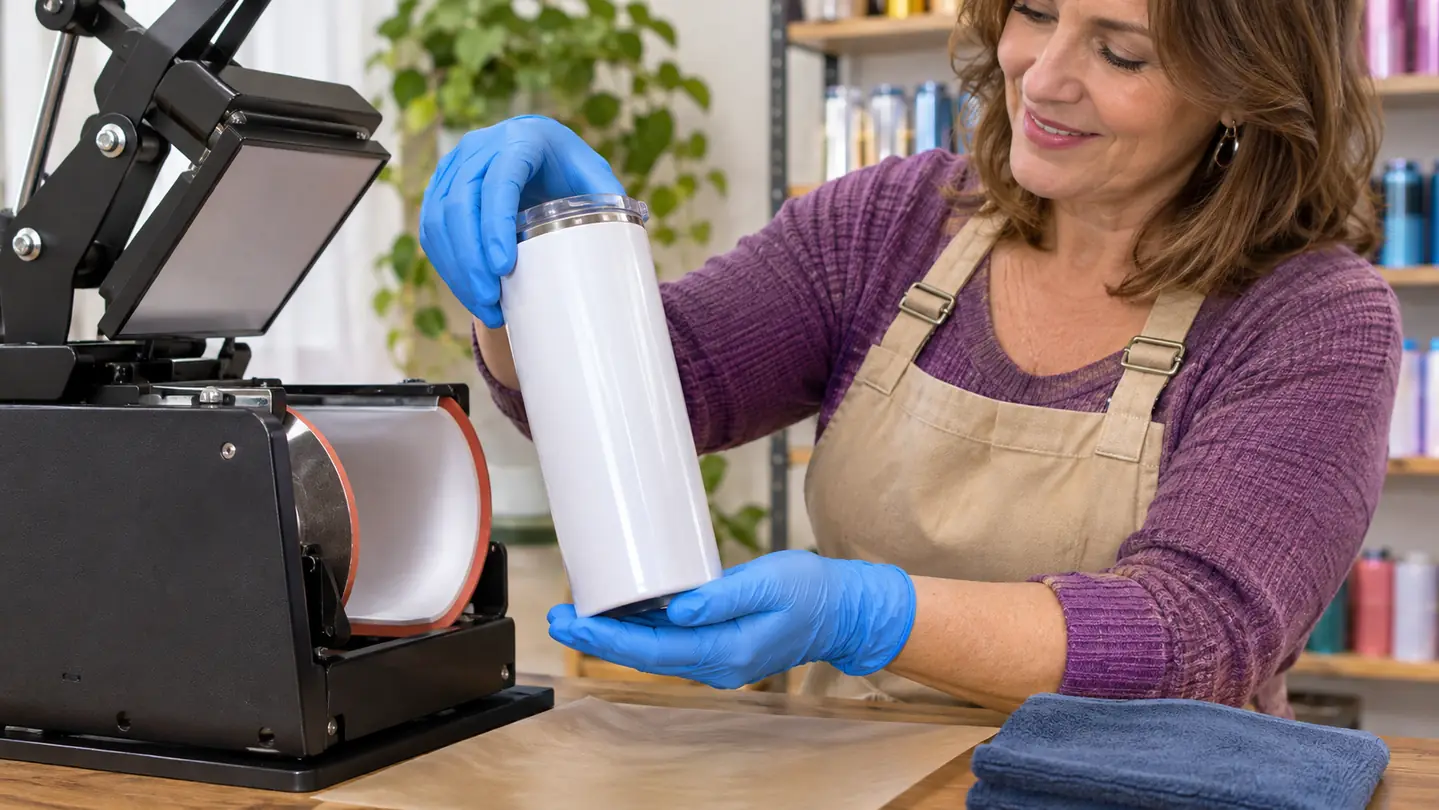
The press works from the other direction. A heated pad clamps against the tumbler and holds it there for the whole cycle. No sleeve, no cookie sheet, no rotating a cup with tongs to find the hot side. That one change is why the second attempt at those six bridal tumblers came out sharp instead of streaked, on the same blanks, with the same designs, in the same room.
The specs matter here in a boring way. The press draws 600 watts on 120 volts, so it runs on the same ordinary outlet as my printer and does not need the dedicated circuit my 15x15 flat press demands. The flat press is 1800 watts and it will trip the breaker if the printer is running on the same circuit. This one will not. It measures 12.9 by 10.9 by 6.3 inches and weighs 4.92 kg, which is light enough that I can slide it to the back of the table when I need the front for layout.
Why this press and not the oven my friend Pam uses? Because I press tumblers a few at a time, in a bedroom, next to a printer. An oven is a bigger footprint and a bigger learning curve for a batch size I do not have. Pam's garage has a bench down one wall, blanks in bins underneath, and room to walk around a hot box. My folding table is set up for Thursday night. Buying the tool that matches the room you actually have is most of the decision, and it took me one bad Saturday in April to learn it.
The Clamp, the R Button, and the Timer on My Phone
Almost every review of a tumbler press talks about results and skips the clamp. The clamp is the part that decides whether you can do this at nine at night after a full day of answering phones. This one clamps itself. You seat the tumbler, close the heated pad over it, and the machine holds it. You are not squeezing a handle for two and a half minutes.
That sounds like a small thing. It is not. With the old setup I hovered, checked the sleeve, nudged the cup with tongs, and opened the oven door twice to see if the wrap had moved. With this one I clamp, start the timer on my phone, and spend the 150 seconds weeding vinyl or folding shirts. That is the entire value of the machine to me, and it is why tumbler night stopped being the night I dreaded. A handle you have to hold is a handle that owns your evening.
The R button stops the heat and releases the pad in one motion. It is the normal exit at the end of a cycle and the emergency brake in the middle of one. I have used it mid cycle exactly once, on a night in June when I realized I had loaded a tumbler with the design about a quarter inch low. I hit R, the pad lifted, and I peeled the paper off while the cup was still warm enough to re-tape. Then I reloaded, ran the full 150 seconds again, and the print landed where I wanted it. Without that button I would have thrown the blank in the reject box and started over.
Now the part the listing does not promise. There is no timer I rely on, so I run one on my phone. If you are the type to wander off, this press will not rescue you. It will keep heating while you are in the kitchen. I fixed that by making the timer my only task for those two and a half minutes, phone in hand, thumb on the button. A tumbler left sitting well past its time can come out with a soft bottom edge and a tired-looking design, so I do not answer a text mid cycle.
Three Tenths of an Inch Is the Whole Window
The press takes tumblers from 2.9 inches to 3.2 inches across, and from 10 oz to 30 oz, which the listing also gives as 280 ml to 850 ml. That range covers the 20 oz straight tumbler most people start with. It does not cover everything in the kitchen cabinet, and the photos make the machine look more universal than it is. Before you order, take a ruler to the tumblers you already have and measure across the middle, not across the rim. A rim flares, and a flare will fool you into thinking a cup fits when it does not.
Tapered tumblers are where it gets awkward. The pad clamps on the widest point, so a cup that narrows toward the bottom sits slightly off and presses unevenly. A tapered cup tends to come out with the lower third of the design lighter than the top, which is why I stick to 20 oz straight tumblers. If you sell tapered drinkware, this is not the machine for them, and no amount of tape fixes geometry. Straight walls are not a preference here. They are the requirement.
My 20 oz blanks sit flat every time, and that repeatability is what makes the press worth owning. I keep a small ruler in the drawer with the heat tape and the scissors, and anything new gets measured before it goes near the pad. One cup from my own cabinet came in at three and a half inches across the middle, well outside the window, so it never made it to the press at all. It is still in the cabinet. It can stay there.
What I Liked
- The clamp holds the tumbler by itself, so your hands are free for the whole cycle
- The R button stops the heat and releases the pad in one motion
- The 210 to 390 F range covers the 365 F I use for 20 oz sublimation tumblers
- Fits on a folding table at 12.9 by 10.9 by 6.3 inches and 4.92 kg
- Straight 20 oz tumblers come out the same way every time, which is the whole game
Where It Falls Short
- One tumbler per cycle, so a batch is an evening
- Tapered tumblers do not sit right and press unevenly
- The tumbler is very hot when it comes out, so gloves are not optional
- You time the cycle yourself with a phone or a kitchen timer
- One year warranty on a machine with a heating element
Three tenths of an inch is the entire size window. Measure your tumbler across the middle before you order, not across the rim.
Heat, Gloves, and Six Months of Real Use
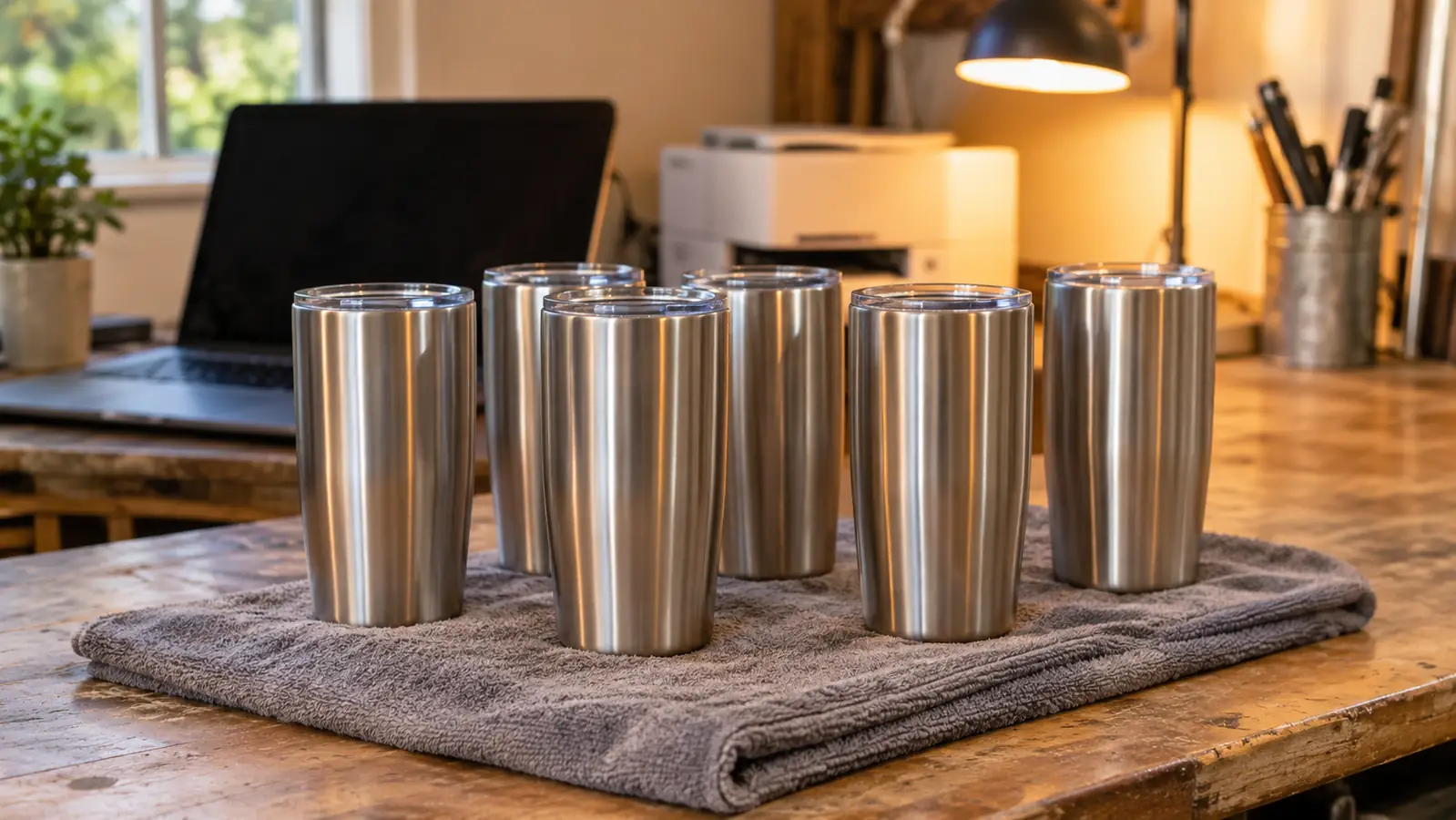
The tumbler comes out hot. Not warm, hot, and the pad holds heat for a while after the release. I keep heat gloves on the table and use them every time, including the last cup of the night when I am tired and want to be done. A folded towel beside the press is where finished tumblers cool before I touch them again. In the first month I grabbed a cup too soon and set it down fast. Now I count to ten with the gloves still on before a finished tumbler leaves the table.
The temperature range runs 210 to 390 F. I use 365 F for 20 oz sublimation tumblers and I have no reason to go higher. The machine goes where you tell it to go. It will not tell you what the blank in your hand can take, so that part is on you and on the paper and blank instructions. If a blank comes with a suggested range, follow the blank, not me. My 365 F is my number for my blanks, and it took a test cup to land on it.
Two heat sources in one room means I run them in sequence, not at the same time. Flat press for the vinyl shirts, then the tumbler press for drinkware, with the printer filling in between. That is not a rule from anyone. It is how I keep from standing in a hot room second guessing which machine is doing what. In July I ran the flat press first thing in the morning, before the room had a chance to warm up, and saved tumblers for the evening after the sun came off that window. In January it will be the other way around.
Six months in, the HTVRONT clamp closes the same way it did in week one. The pad shows some honest wear and presses the same as it did in May. I have not had a warranty issue, so I cannot tell you how the one year coverage works in practice. I can tell you I read it before I ordered, and a year is short for anything with a heating element in it. That is my one real reservation about the machine, and six months of use cannot settle it.
The press stays on the folding table by the window. I crack the window while it runs, mostly because the printer is in the same room and the room gets warm. That is not a requirement in the manual. It is what a person does in a spare bedroom with two heat sources and a husband who does not want the house smelling like a workshop. Gary has never once said the room smells. He has said the hallway does.
Who This Is For
This is for someone pressing straight walled tumblers in small batches, the way I do. Coworkers, neighbors, a church table, a Saturday fair. You want the clamp to hold and the heat to be repeatable, and you are willing to run one cup at a time while you do something else with the two and a half minutes.
It is also for the person who tried shrink wrap sleeves and a countertop oven and got streaky results. The HTVRONT press fixes the pressure problem an oven cannot fix. If your design is good and your paper is right, the difference shows on the first tumbler, not the tenth. That was the part that surprised me most in May, and it is the part I still bring up when a coworker asks whether the machine is worth owning.
You should also be fine with measuring. The 2.9 to 3.2 inch window is not a suggestion, and a cup that does not fit will not be fixed by pressing harder. I keep a small ruler in the drawer with the heat tape and I check anything new before it goes near the pad. If that sounds fussy, it is. It is also the difference between a cup that leaves the table and a cup that goes in the reject box.
Who Should Skip It
If you need a batch out the door in an hour, skip it. One at a time is the honest limit. A sublimation oven, the kind my friend Pam has in her garage, is built for volume in a way this press is not, and I would rather say that than pretend otherwise. She can load a rack and walk away. I load one cup and stand there with a phone in my hand.
If you mostly press tapered cups, skip it. The clamp wants straight walls. And if you want a machine that times itself so you can walk away, this one will not do that for you. You will be standing there with your phone in your hand, and that is the deal you are making. It is a fair deal for what I do. It may not be a fair deal for what you do, and only you know which one that is.
Measure your tumbler first, then decide
The press does exactly what the listing says, on the cups the listing names. Check the size range against the blanks on your shelf, and if they line up, look at today's price.
Amazon Check Today's Price on Amazon →