If you are standing in a spare bedroom trying to decide what to buy first, here is the short answer. The HTVRONT Auto Tumbler Heat Press is the easier machine to learn on, and a sublimation oven is the easier machine to run in a batch. Those two sentences look alike and they are not, and it took me an afternoon in my friend Pam's garage to understand why.
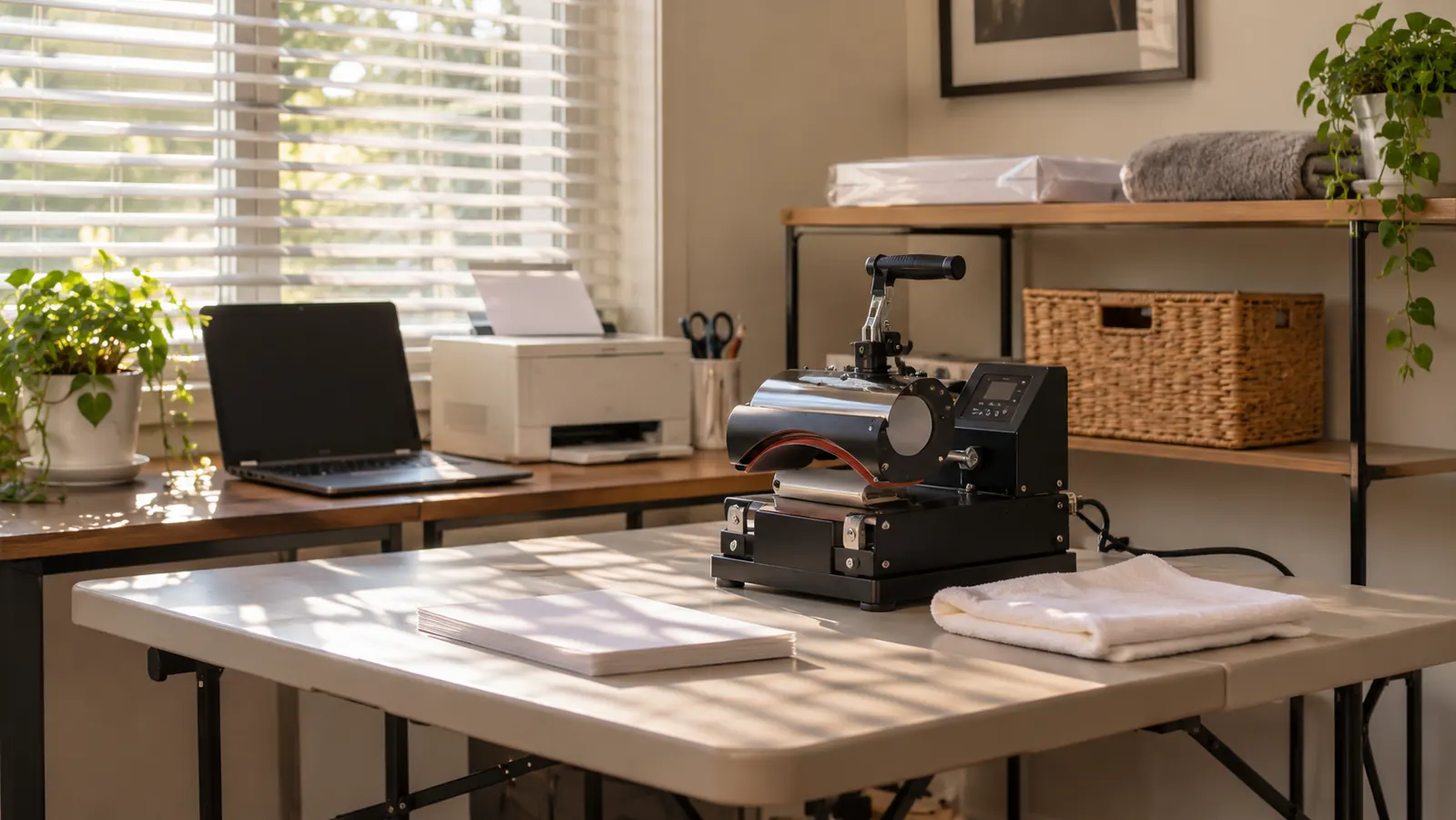
I press 20 oz straight tumblers at 365 F for 150 seconds in the HTVRONT, one at a time, on a folding table by the window in my spare bedroom in Evansville. I have done it that way since the first week of May, so a little over six months now. Pam keeps a sublimation oven on a bench in her garage. I have loaded blanks into hers, watched her run a batch, and asked her a lot of questions about it. I have never owned one. Anything I tell you about the oven comes from her garage and from reading the listing, and I will say so again when it matters.
| HTVRONT Auto Tumbler Press | A sublimation oven | |
|---|---|---|
| Learning curve | One clamp and a temperature setting, no wrap to fold | Every blank taped, wrapped and sleeved before it goes in |
| Tumbler fit | 2.9 to 3.2 inches across, 10 to 30 oz | Anything that fits through the door, tapered blanks included |
| A batch of ten | One at a time, roughly two and a half minutes each | Four or five per round, hands free while it runs |
| Footprint | 12.9 by 10.9 by 6.3 inches, lives on a folding table | An oven body plus sleeves, a rack and its own outlet |
| Consistency | Same pad pressure and contact on every press | Depends on how evenly the sleeve shrank |
| Stopping a bad press | Press R and the pad releases immediately | Open the door and pull a hot tray |
| Warranty | 1 year, stated on the listing | Varies by brand, and sleeves are consumables |
| Best for | One-off gifts and small runs for people you know | Fifteen identical blanks in one evening |
How I Ended Up Comparing These Two
My first tumbler setup was the cheap way in. An old countertop toaster oven sitting on the folding table by the open window, a pack of shrink wrap sleeves, and a converted EcoTank printer. It was a crafts-only oven, never food, and I say that plainly because people always ask. It worked well enough in February that I kept going with it for a few months. It stopped working well enough on a Saturday in late April.
A set of six tumblers for a friend's bridal party came out blurry, with streaks down one side of four of them, and the EcoTank clogged that same afternoon. I sat on the floor of the spare bedroom and decided I was done improvising. In the first week of May I bought the Epson F170, a pack of A-SUB paper, and the HTVRONT tumbler press. I remade those six tumblers the next Saturday and they came out sharp. Nothing about that has changed in six months. The press has not broken, I have not had to call anybody about it, and the only thing I have replaced is paper.
Pam's garage is the other half of this comparison. Her bench has the oven on a shelf, sleeves in a bin underneath, and a rack of blanks beside it. When I want to see how a job would go the other way, I bring blanks over on a Saturday and we run some in her oven and some in my press. Same blanks, same designs, two machines. That is genuinely all the testing method I have, and it is enough to tell you where each one is easier.
Where the HTVRONT Auto Tumbler Press Wins
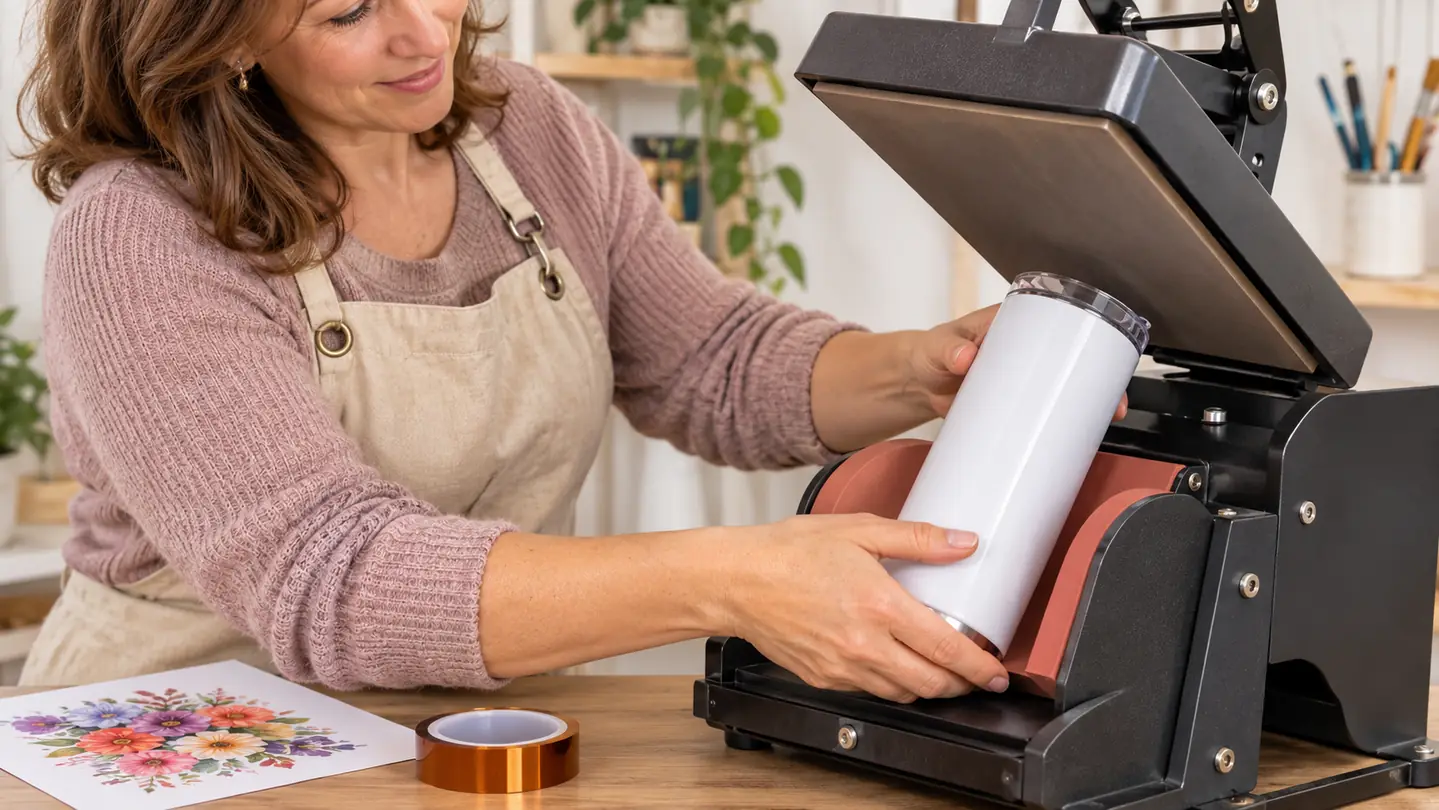
Consistency comes first. The press clamps the pad against the tumbler at the same pressure every single time, at whatever temperature I dial in between 210 and 390 F. I set 365 F and 150 seconds, close it, and walk away until it beeps. There is no wrap to fold around a curved blank, no sleeve to shrink, and no judgment call about whether a seam is tight enough. When I make six tumblers for six different people, they match each other. For a beginner, matching is most of what you are being graded on, and this machine hands it to you before you have any skill at all.
Second, it fits where I actually work. It measures 12.9 by 10.9 by 6.3 inches and weighs about 4.92 kg, so it lives on the folding table by the window and goes back on the shelf when I need the table for cutting vinyl. It runs at 600 watts on 120 volts, which means it shares the bedroom circuit with my laptop and the printer and nothing trips. Pam's oven wants its own outlet on the garage wall, and it holds a shelf plus a bin of sleeves plus a rack of blanks. If your work area is a card table, that difference is the whole decision, not a footnote.
Third, and this is the one I did not expect to care about, the R button. If a design looks like it slipped, or I simply want the blank out, I press R and the machine stops heating and releases the pad instantly. In an oven you cannot do that. You open the door, reach for a hot tray, and hope you are quick enough to save the run. It is a small thing on paper, but knowing that button is there makes the whole process calmer.
Where a Sublimation Oven Wins
Volume, and I want to be fair about it. Pam can load four or five tumblers into her oven at once, wrapped and sleeved, close the door, and set a timer. Then she walks away and does something else while it runs. I press one tumbler at a time, about two and a half minutes of pressing plus loading and unloading, and I am standing at that table for all of it. If you have fifteen identical tumblers to finish in an evening, her oven is done in three rounds and I am still on number seven.
Shape and size is the second thing. My press handles tumblers from 2.9 to 3.2 inches across and 10 to 30 oz. That covers every blank I make and I have never needed more. But it is a range, and outside that range the press has nothing to hold. An oven with a shrink wrap sleeve only cares whether the blank fits through the door. Tapered tumblers and bottles with a shoulder go in without a fight. My one real gripe with the press sits exactly here: a tapered tumbler does not sit right, and I stopped buying them because of it.
The third is pressure. A sleeve applies pressure evenly around the whole blank at once. A pad applies it from one side. On a straight 20 oz tumbler I cannot see a difference in the finished product, side by side, same design, same day. On a blank with a shoulder or a handle, I would want the oven, and I would not argue about it with anybody.
A sleeve pushes evenly around the whole blank. A pad pushes from one side. On a straight tumbler I cannot see the difference. On anything else I would want the oven.
Start With the Machine You Can Run on a Weeknight
One tumbler at a time, same pressure, same result, no wraps and no sleeves to buy. That is what changed my Saturdays after the toaster oven.
Amazon Check Today's Price on Amazon →What a Cycle Actually Looks Like on Each Machine
On mine, the whole job is four moves. Slide the tumbler in, close the pad, set the temperature and time if they are not already where I left them, and press R when it finishes. If I am doing a run of six, I stage the six designs on the table in order, load one, and write labels for the next while it presses. A set of six takes me a little over half an hour including cooling time, and the limit is my own attention, not the machine. That matters more than it sounds like it should. A machine that waits for you is a machine you will actually use on a Tuesday after work.
On an oven, the work happens before the heat. Every blank gets a printed sheet taped down, then a sleeve pulled over it and shrunk with a heat gun until it hugs the tumbler evenly all the way around. That is a skill, and Pam is better at it than I am after two tries. Then the tray goes in, the door closes, and the waiting starts. It is a different rhythm. More setup, less standing.
The Parts Nobody Warns You About
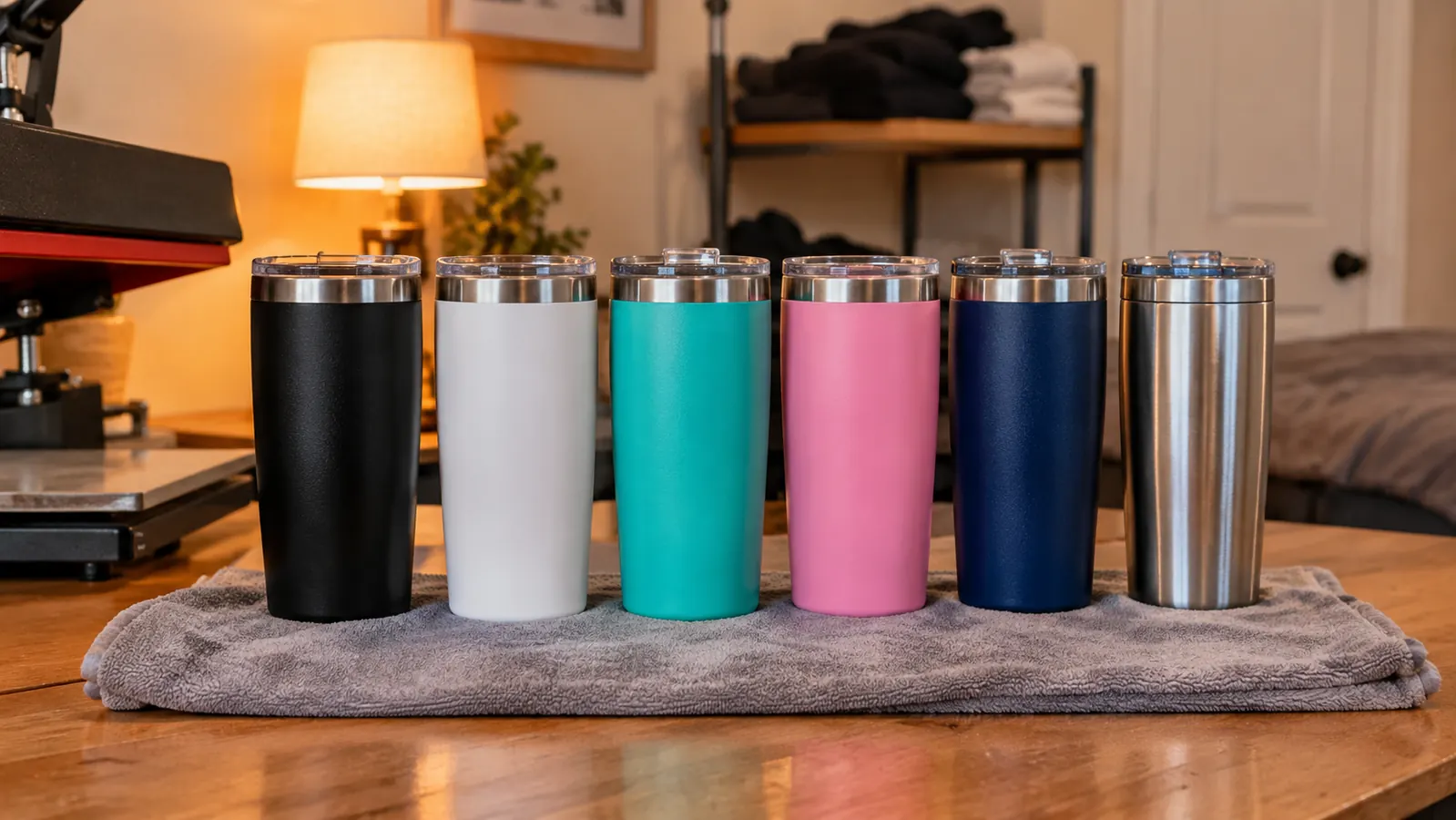
For the press, it is heat. The tumbler stays very hot after the pad releases, so I wear gloves every single time, not most times. There is also a real limit I hit early on: one tumbler at a time means one tumbler at a time, and no amount of planning around it changes that. And this machine is built for straight drinkware in that 2.9 to 3.2 inch range, so if you fall for a tapered blank at the craft store, you are going to be disappointed when you get it home.
For the oven, it is sleeves and space. Shrink wrap sleeves are a supply you keep buying, and every size of blank wants the right size of sleeve. The oven is a permanent footprint on a bench, plus the bin and the rack and the gun. And the thing Pam says more than anything else is that you should never walk away without a timer set and a note of what you set it to, because a batch that overbakes is a batch of four or five, not one.
What I Would Tell a Beginner Standing in My Spare Bedroom
Do not buy both. That is the first thing. They solve the same problem from two directions, and owning one of each means owning two setups you half understand and no shelf space left. Pick the machine that matches the work you actually have this month, not the work you imagine having in a year. My work this month is a handful of tumblers for people I know, and one at a time has never once been the reason something was late.
Second, let the machine carry the part you cannot do yet. I could not wrap a tumbler evenly in April. Pam can, and it took her practice I did not have. The press closes that gap for you on day one, which at the beginning matters more than any amount of capacity. Third, buy the blanks the machine was built for. Straight 20 oz tumblers, within that 2.9 to 3.2 inch range, and the whole thing gets boring in the best possible way. Boring is what you want in your first six months.
Who Should Buy Which
Buy the HTVRONT tumbler press first if you are one person working evenings and Saturdays, if your space is a folding table, if orders arrive one or two at a time from coworkers and church and neighbors, and if the thing you are most afraid of is ruining a blank. The clamp does the part you do not know how to do yet, and the R button gives you an out when a design slips. It is also the machine I would hand to somebody who has never pressed anything in their life. Straight 20 oz tumbler, 365 F, 150 seconds, gloves on the counter. That is the entire learning curve.
Buy a sublimation oven instead if you already know you are making batches. If a Saturday means fifteen identical tumblers for one event, if you want tapered blanks and odd bottles in your lineup, or if you have a bench with a dedicated outlet and room for sleeves, the oven will run circles around a single-tumbler press. Pam's does. But she had to learn the wrap before the oven did anything useful for her, and that learning is the part nobody shows you when they hold up the finished tumbler.
The One That Fits on a Folding Table
Auto clamping, 210 to 390 F, 10 to 30 oz blanks, and a one year warranty on the listing. It is the machine I still use every week.
Amazon See It on Amazon →