The six tumblers came out of the oven blurry. It was a Saturday in late April, a bridal party order for a friend, and every one of them had a soft edge and a streak running through the lettering. I set them on the workbench and went to check the printer, and the print head on the converted EcoTank I had been limping along with since February had clogged. I did not cry, but I thought about it for a while. The following week I ordered the Epson SureColor F170, a pack of A-SUB sublimation paper and the HTVRONT tumbler press, all at once, out of my own pocket. I remade the six tumblers the next Saturday and they came out sharp.
That was the first week of May. I have had the F170 about six months now, printing on weeknights after work and on Saturdays, and it has not clogged once. My name is Darla Vickers. I am forty-nine, I answer phones at a dental office in Evansville, Indiana, and I make shirts and tumblers in a spare bedroom for coworkers, neighbors and my church. Nobody sent me this printer and nobody paid me to write this. I bought it with my own money, and I am writing it down because most of the reviews I read before I ordered were from people who print for a living, not people who print after supper.
The Quick Verdict
The F170 is the piece I should have bought in February instead of a converted EcoTank. Sharp transfers, genuine Epson ink in the box, six months without a clog. It only prints up to 8.5 x 11, it cannot print white, and it costs a good deal more. I would still buy it again tomorrow.
Amazon Check Today's Price →Six tumblers, one printer, no more guessing
The F170 is what I moved to after my converted EcoTank clogged in the middle of an order. It arrives with a full set of genuine Epson sublimation ink and prints up to 8.5 x 11, which covers every shirt front and 20 oz straight tumbler I make.
Amazon Check Today's Price on Amazon →How I've Used It
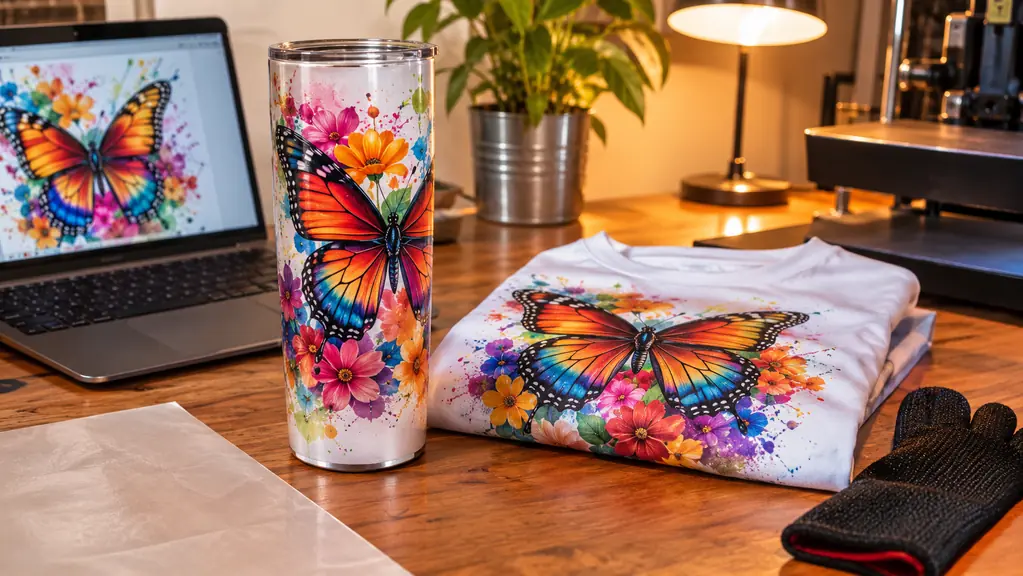
Everything I print on the F170 gets pressed onto polyester. I print the mirrored design on A-SUB paper, trim it with scissors, tape it to a white or light polyester shirt with heat tape, and press at 385 degrees for 50 seconds on the Fancierstudio 15x15 clamshell my husband Gary built the bench for. Tumblers go onto the HTVRONT tumbler press at 365 degrees for 150 seconds. Cotton shirts never go near the F170, because sublimation will not bond to cotton. Those get Siser EasyWeed cut on the Cricut I already owned, pressed at 305 degrees for 15 seconds and peeled hot.
So the F170 does one job in my house. It prints flat sheets, 8.5 by 11, and nothing else. The listing calls it print only and that is exactly right. There is no scanner. I have never once wished it could scan. I have wished it could do an 11 by 17, but not often, and not for anything a customer has actually asked me for.
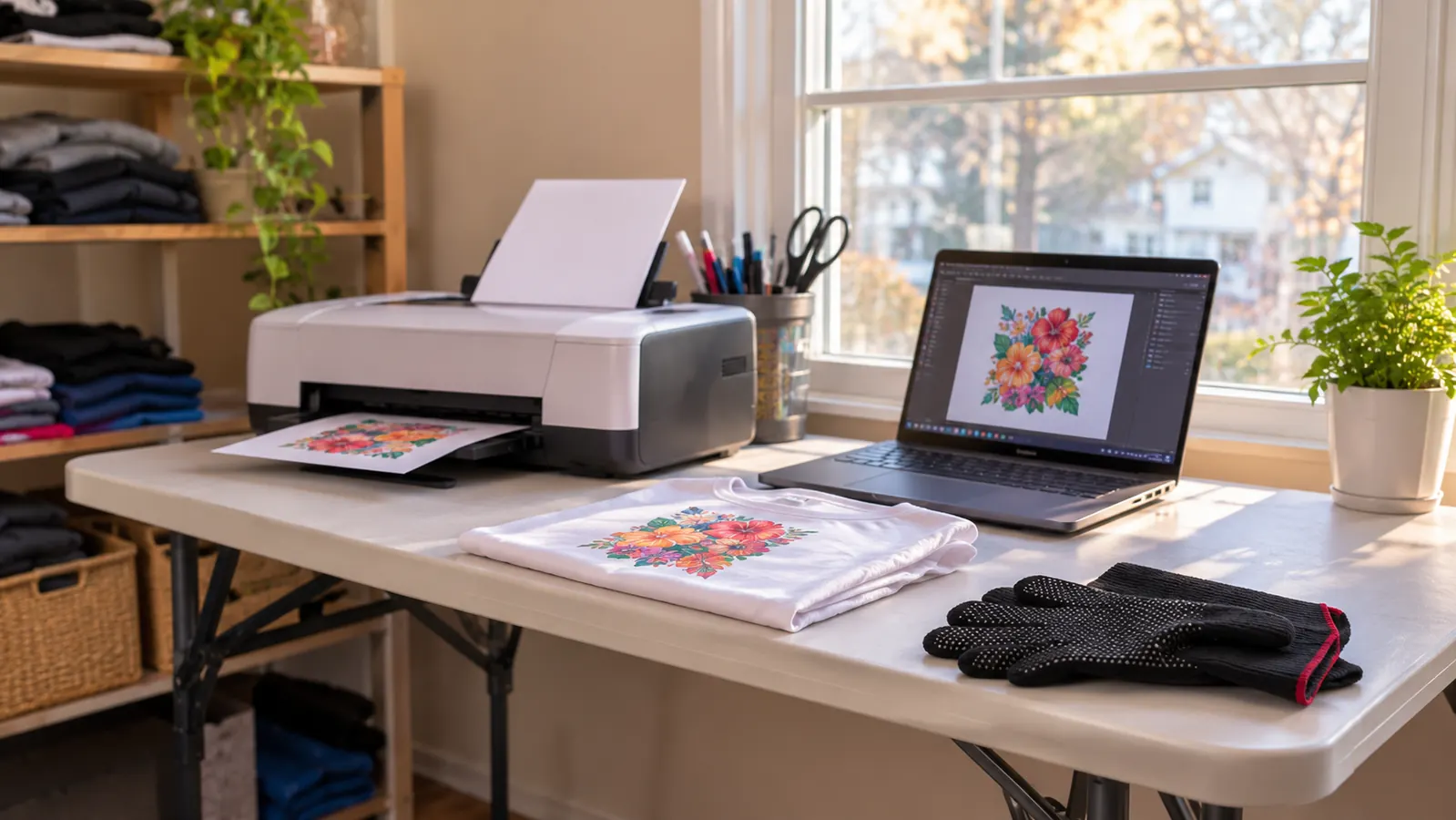
It sits on the second folding table by the window beside the tumbler press. The printer weighs about 16 pounds and measures 13.7 inches deep, 14.8 wide and 7.4 tall, so it does not swallow the table. I print from my Windows laptop and have not needed anything else. I keep the paper flat in a drawer underneath because A-SUB curls in a humid room, and I check the print side every single time, because the wrong side up gives you a transfer so faint you will swear the machine is broken.
A Tuesday in September is a fair example of the workload. A coworker's daughter needed shirts for a volleyball team, six of them, and I did the whole batch after supper. I laid the designs out two to a sheet where they were small enough, printed six sheets, trimmed each one with scissors on the workbench, and stacked them printed side up so nothing smeared. The printing itself took maybe twenty minutes. The pressing took the rest of the evening, one shirt at a time at 385 degrees for 50 seconds. I could not have done that on the EcoTank, because two or three of those sheets would have come off banded or faint and I would have spent the night reprinting instead of pressing.
What the Prints Actually Look Like
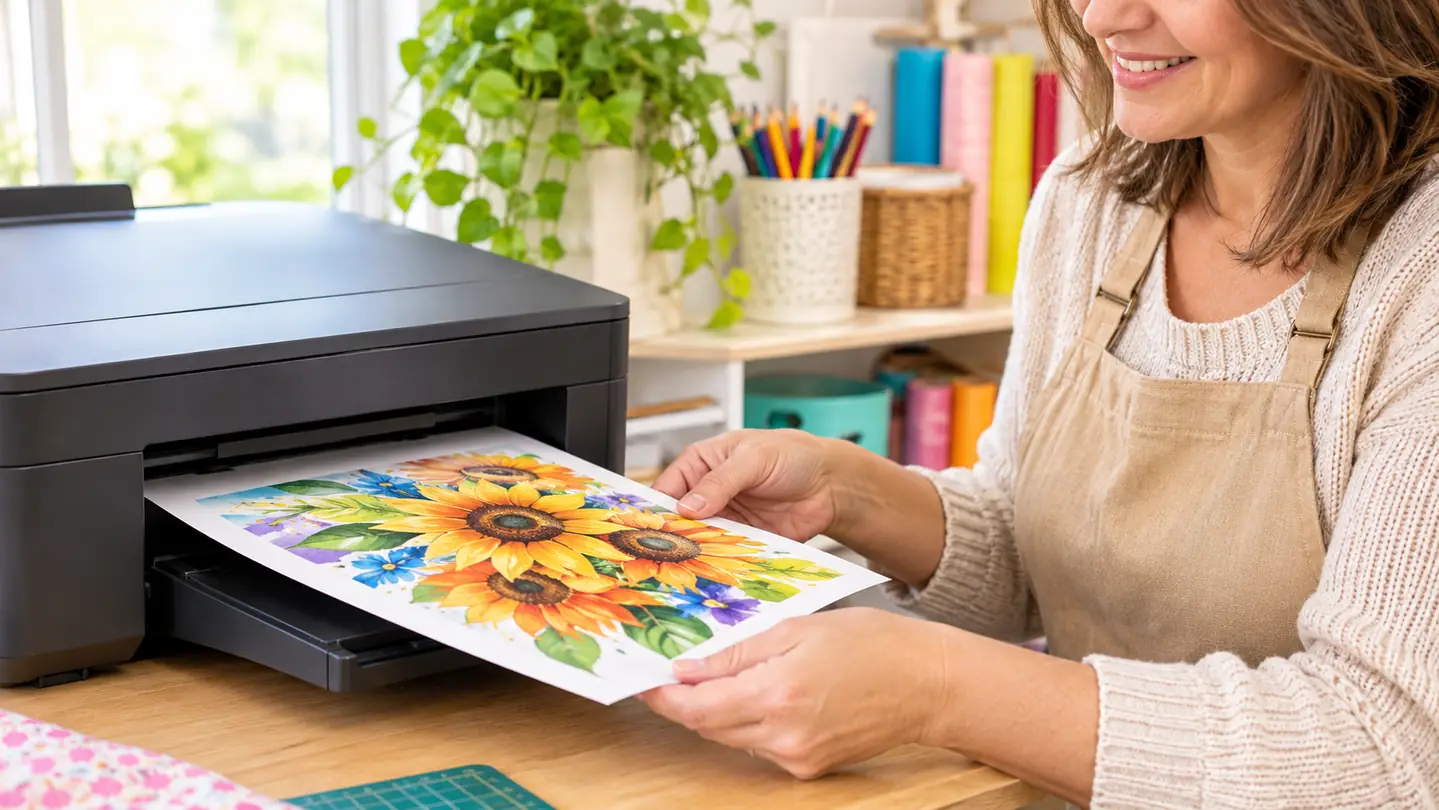
The first sheet I pulled off the F170 went onto a polyester shirt, and I held it up to the window. The difference between it and anything the EcoTank had produced was not subtle. Blues were deep, the edges of the lettering were crisp, and there was no banding across the middle of the image. The F170 runs at 5760 x 1440 through Epson's PrecisionCore printhead, and I am not the person to explain what those numbers mean, but I can tell you what they look like on a shirt in daylight.
The ink matters as much as the head. The printer arrives with a full set of genuine Epson sublimation ink, the ECO PASSPORT by OEKO-TEX certified bottles, and they have auto-stop tops so you fill them without a funnel and without a spill. I have refilled them a number of times now and I have never had a bottle tip or dribble down the side. On the converted EcoTank I was buying third-party ink and guessing, and every batch carried a little doubt along with it.
The real test is the wash, though. My first batch of shirts off the F170 went out in May for the dental office fundraiser walk, and I asked one of the women about a month later how hers was holding up. She sent me a photo in August, after a summer of regular washing, and the print was still saturated, with no cracking and no fading at the edges. That is the difference between a transfer that looks good on the bench and one that still looks good in October. I cannot explain the chemistry of it. I can tell you that genuine Epson ink, the right polyester and the right temperature are what got me there.
Resolution does not rescue a bad transfer, either. If the paper is wrong side up or the press is running cold, the printer cannot save you. Those late-April tumblers were not only a printer problem. Part of what went wrong was me learning that shrink wrap over a countertop toaster oven is not a controlled press. Buying the tumbler press the same week as the F170 was not a coincidence. I wanted both halves of the problem solved at once.
Same design file. Same tumbler press. Same hands. The only thing that changed between the streaked batch and the sharp one was the printer.
The 8.5 x 11 Ceiling, and Why It Hasn't Hurt Me
Understand this before you order. The F170 is a compact format machine. 8.5 by 11 is the whole of it. If you want to print across the back of a hoodie in one piece, this is the wrong printer. If you want wide decor panels, you will be piecing and cursing, and it will show.
My work is shirt fronts, small chest prints and 20 oz straight tumblers. A tumbler wrap fits comfortably inside an 8.5 by 11 sheet and so does a shirt front. In six months I have not outgrown it. The one request that did not fit came in July, from a neighbor who wanted a single large design across the back of a hoodie. I measured it out on the workbench and it would have needed a sheet roughly twice as wide as the F170 will feed.
I could have split it into two pieces and lined them up on the platen. I have seen that done and it looks fine when somebody patient does it. Getting a seam to disappear across the back of a hoodie takes more practice than I have, and I was not willing to hand over something with a visible join and hope she did not notice. I told her no and pointed her to a shop in town that runs wide format. She came back in August for six tumblers, so I do not think the honesty cost me anything.
The tray helps more than I expected. The F170 has a 150-sheet auto-feed tray, so when I am printing a dozen wraps for a Saturday order I load the paper, send the files, and walk away to cut vinyl while it works. I am not standing over it feeding one sheet at a time.
The Weekly Habit That Keeps the Ink Moving
Sublimation ink sitting still is what killed my EcoTank. It clogged in April after a week when I did not print anything at all. So I made a rule for myself: every Sunday evening, before I start anything, I run one small test print. A block of color or a design I already have saved on the laptop. It takes two minutes and it uses a little ink, and I have not had a clog since May.
There was one week in July when I skipped it. Kayla came down from Louisville for a long weekend and Sunday evening came and went without a thought from me. When I sat down the following Wednesday to print a set of tumbler wraps, the first sheet came out with a thin white line running through a block of solid color. I sent two more plain color blocks through it and the line cleared. That was the worst of it, and I have not skipped a Sunday since. That single line is the whole reason I am strict about it now.
That is not a feature of the printer. That is maintenance, and I want to be clear about it. I would not call the F170 self-cleaning and neither does the listing. I also crack the window while the press is running, mostly for the heat, and the printer lives right beside it.
The other habit is paper. I use A-SUB 8.5 by 11, 125g, 110 sheets to a pack, stored flat in a drawer. When I first moved over I was still finishing the generic no-name paper I bought in February, and the transfer edges on that paper were softer. Switching to A-SUB was a one-time correction, not a running battle. I still check the print side before every run because that paper will not tell you when you have it backwards.
What It Costs to Run Compared to a Converted Printer
The honest gap is up front. The F170 costs considerably more than an EcoTank plus a conversion kit, and I am not going to pretend otherwise. That is the real reason people start with the converted route. It is certainly the reason I did.
What I got for the difference was six months with no clog, no ink on my fingers, transfers that match the file on the screen, and a machine designed to do this one thing instead of a machine I altered to do it. My converted EcoTank is boxed in the closet now. I have not opened it since May and I do not expect to.
On ink, the printer takes Epson T49 bottles and I refill from the auto-stop tops. I am not going to quote you a cost per shirt, because I have never sat down and worked it out properly, and anyone who gives you that number with total confidence is probably selling something.
What I Liked
- Sharp, saturated transfers from the first sheet, with no banding across the image
- Full set of genuine Epson sublimation ink included, ECO PASSPORT certified by OEKO-TEX
- PrecisionCore printhead at 5760 x 1440 resolution
- 150-sheet auto-feed tray means batch orders run without babysitting
- Auto-stop ink bottles refill clean, with no funnel and no spill
- Print only, so you are not paying for a scanner you will never lift
- Six months of weeknight and Saturday use with zero clogs
Where It Falls Short
- Locked to 8.5 x 11, so wide format work is simply off the table
- Costs far more up front than converting an EcoTank
- Cannot print white, so dark and cotton shirts still need vinyl
- Wants a small test print every week or so to keep the ink moving
- Takes Epson T49 ink only, and I would not trust a third-party substitute
- At 16 pounds and roughly 14 by 15 inches, it wants a table of its own
Who This Is For
This is for someone who has already decided sublimation is the thing they want to do and is tired of fighting their equipment. You print shirt fronts and 20 oz straight tumblers. You work from a folding table or a counter, not a shop floor. You want to open a box, fill the bottles, load paper and print something that looks like the file on your screen.
It is also for anyone in my exact spot: an order every week or two, a church group, coworkers, one craft fair in the fall. That volume does not need a wide format machine, and it does not need a second loan.
Who Should Skip It
Skip it if you need to print wider than 8.5 by 11, because you will hit that wall in the first month and no amount of good color will fix it. Skip it if your main product is dark shirts or cotton, because this printer cannot print white and you will be cutting vinyl for those anyway. Skip it if you only print once a month, because the ink wants to move and you will be running test prints whether you feel like it or not.
And skip it if buying it means you cannot also afford a decent press. The printer is half of the equation. A perfect print pressed on an uneven platen is still a ruined shirt. I would rather you spent the money on a real press and printed on A-SUB paper with a converted machine for a while than the other way around. That is not a popular thing to write in a printer review, but it is what I would tell you at my kitchen table.
The half of the problem I wish I'd bought in February
If you are going to print sublimation more than once a month, buy the machine that was built for it. Genuine Epson ink in the box, 8.5 x 11 flat sheets, and six months of my own weeknight use with no clog.
Amazon Check Today's Price on Amazon →