
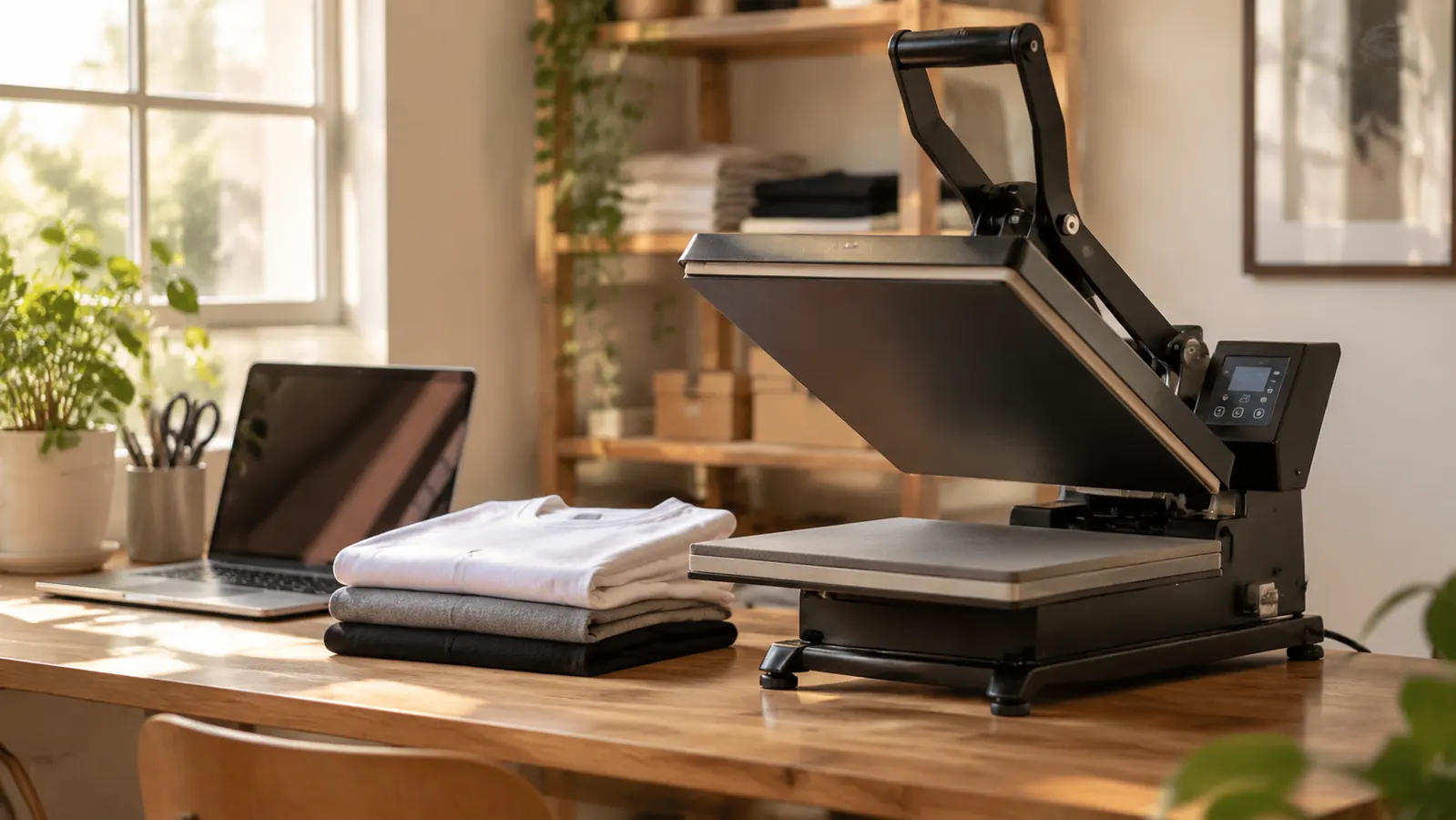
I bought the Fancierstudio 15x15 clamshell in the first week of February with my own money, after four coworkers at the dental office asked whether I could make shirts for a fundraiser walk. Before that, the only pressing tool in this house was a household iron and a folded bath towel on the kitchen table, and the vinyl on my December Christmas shirts had already started lifting in the wash. I am not a printer and I am not a shop owner. I am a receptionist in Evansville, Indiana, who presses shirts in a spare bedroom on weeknights and Saturdays, and this is what nine months with that machine has actually been like.
What follows is the version I wish someone had handed me in January. Not the listing bullets copied onto a page, but the parts that surprised me: how much room the thing eats, why the number on the panel and the actual platen do not always agree, what a three month warranty means when you are still learning what normal looks like, and why a machine this plain is still the one I reach for every single time I press something flat.
The Quick Verdict
A heavy, simple, dependable flat press that covers a full adult shirt front in one pass. Buy it for the platen size and the repeatable settings, not for the warranty, which is short, or for the temperature readout, which I check with a separate thermometer.
Amazon Check Today's Price →The press that made my vinyl survive the wash
Fancierstudio 15x15 clamshell, 110 volts, 1800 watts, digital time and temperature, teflon coated platen. It does flat work and nothing else, which is exactly why it has stayed on my bench for nine months.
Amazon Check Today's Price on Amazon →What Nobody Tells You Before the Box Arrives
The first thing is the footprint. The listing gives the dimensions as 33 inches long, 23 inches wide and 20 inches high, and I read that number without picturing it. On Gary's bench it takes a whole corner, and the top has to swing up and back, so you need clear space behind the machine as well as in front of it. Measure your table before you order, then measure it again with the press open.
The second thing is the power draw. This is a 110 volt machine rated at 1800 watts, and it wants its own circuit. I had mine on a power strip with the printer and the Cricut for about a week in February before a breaker reminded me that was a bad idea. Now it goes straight into the wall on a circuit that nothing else is using while I work.
The third thing is the warranty. Three months. That is not a typo, and it is the one spec I would change if I could. Nine months in, nothing has gone wrong with mine and I have not had to call anybody about it. But twelve weeks is a short window for a beginner who is still learning what normal looks like, so treat those first weeks as your testing period and put the machine through real work while it is still covered.
The Numbers I Use Every Time
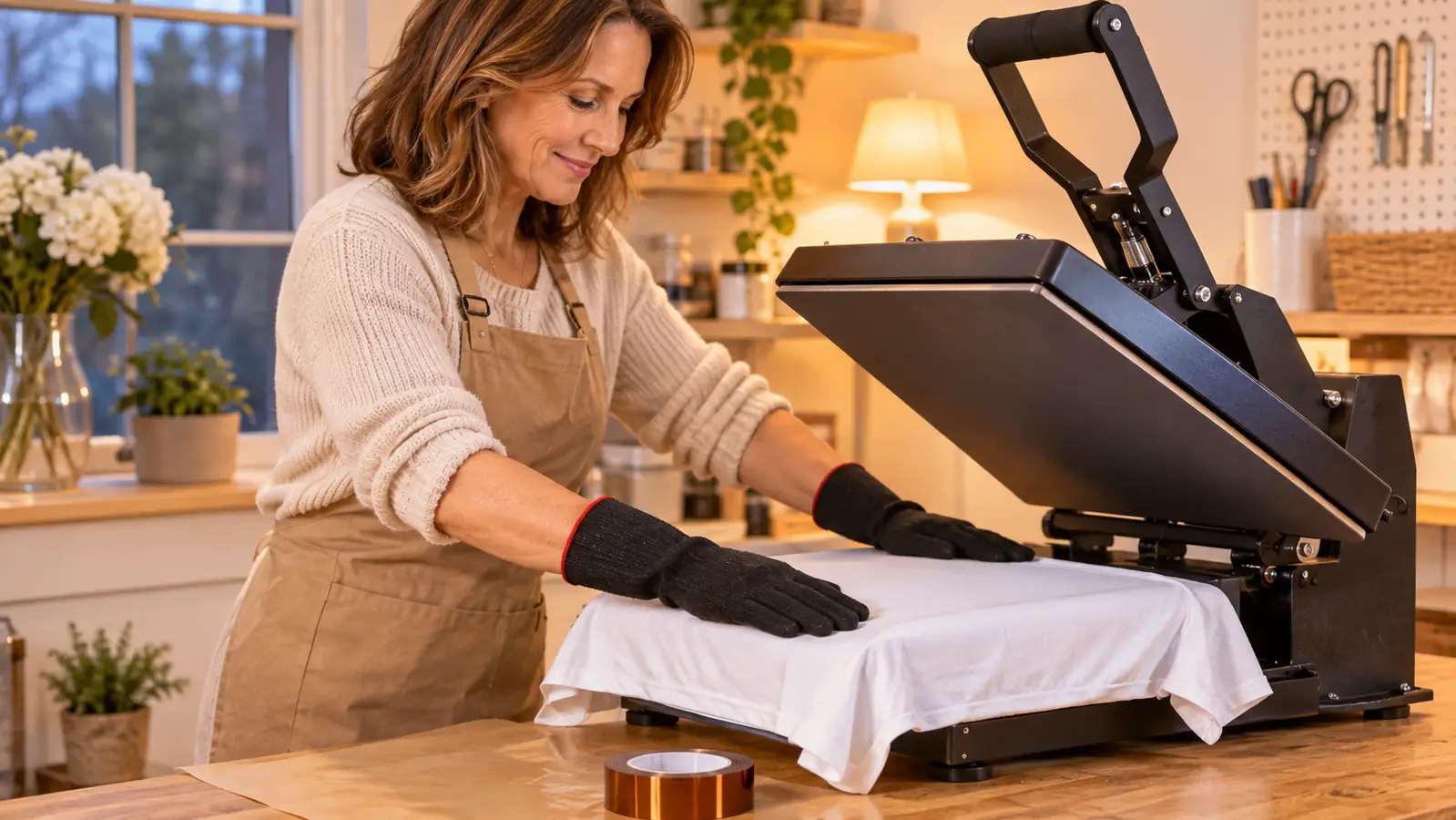
Siser EasyWeed on a cotton shirt goes on at 305 F for 15 seconds and peels hot. Sublimation on a light polyester shirt goes on at 385 F for 50 seconds, with the design mirrored before it prints. Those two settings are the whole job for me, and being able to type them in and get the same result on a Tuesday night as I did back in March is the reason this press stayed on the bench.
The control panel is a digital time and temperature set, and the range on paper climbs much higher than anything I press. I have never taken it above 400 F and I do not plan to. If you are new, the useful part is not the range, it is the repeatability. Set 305 and 15 seconds, press, and the next shirt gets the same. That sounds dull. Dull is what makes a shirt look finished instead of homemade.
The Panel Number Is Not the Platen
Here is the part that would have saved me a few test shirts. The number on the display is not a promise about the surface you are pressing on. I bought a cheap infrared thermometer in March, mostly out of suspicion, and mine reads a little off from what the panel says, enough that I now check the platen before a batch instead of trusting the screen.
I am not telling you the machine is broken. I am telling you to verify rather than assume, because the fix costs nothing. Point the thermometer at the platen, let it settle, and adjust if you need to. A beginner who skips that step will spend a lot of time wondering why one shirt out of five looks different from the rest.
The other habit I picked up is checking the platen after a long gap. If the press has been sitting off for a week, it takes longer than I expect to come back up, and the panel gets there first. That is not a defect, it is just metal warming through, but it is why I check the platen before the first shirt.
Where the Fancierstudio Earns Its Keep
The platen is 15 by 15 inches, and that is the reason I chose this model over a smaller one. A full adult shirt front fits inside it in a single press. With an iron I was moving in sections and guessing at the overlap. With this, the design goes down, the top comes down, the timer counts, and the whole front is done at once. For a beginner, one clean press is much easier to repeat than four partial ones.
The platen also has a teflon coating, which matters more than it sounds. If a bit of vinyl adhesive or a stray thread ends up on the surface, it wipes off instead of baking on. I still lay a teflon sheet or a piece of butcher paper between the platen and the shirt, mostly because I do not want to be the person explaining a scorch mark to a coworker, but the coating has kept the surface itself clean.
And it is a clamshell, which means the top half lifts and lowers as one piece. There is no separate sheet to line up and no second hand needed. The listing names bags and mouse pads alongside shirts, and that single motion covers all of them. For the flat work I do, that is the entire workflow.
Sublimation is the other half of my flat work, and this press handles it the same way. A light polyester shirt, a mirrored print from the printer, 385 F for 50 seconds, and the paper comes away with the image set into the fabric. The platen covers an 8.5 by 11 sheet with room to spare, which is the only print size my printer does anyway.
The Parts That Annoy Me
It is heavy, and it stays heavy. I do not move it. When I needed to clean behind it in June, I waited for Gary, because shifting a machine that size across a bench on my own is how people end up at the walk in clinic. If you are picturing folding this up and sliding it into a closet between projects, picture something else.
The clamshell opens up and toward your hands and face, so the hot platen passes close on the way up. I wear heat gloves and I stand slightly to the side. Nothing has burned me and I would like to keep that record, so I do not rush the lift.
The warranty is three months, which I mentioned above and will mention again, because it is the one thing I want a beginner to hear twice.
And the Fancierstudio press does one job. It presses flat things. It has never touched one of my tumblers and it never will, because a tumbler does not sit in a clamshell and get even pressure around the curve. If tumblers are on your list, that is a different machine, and I ended up buying one in May after a rough Saturday in April showed me the toaster oven route was not going to work.
What I Liked
- 15 by 15 inch platen covers a full adult shirt front in one press
- Digital time and temperature holds a setting, so the second shirt matches the first
- Teflon coated platen wipes clean instead of collecting baked on adhesive
- Single clamshell motion, no separate sheet to line up
- Nine months of weeknight use with no repair and no service call
Where It Falls Short
- Heavy and awkward to move, so it needs a permanent spot on a sturdy bench
- Three month warranty is short for someone still learning the machine
- The display and the actual platen surface can disagree, so a separate thermometer helps
- Flat work only, no tumblers or curved blanks
I press Siser EasyWeed at 305 F for 15 seconds, peeled hot, the same numbers I typed in during February, and that repeatability is what keeps the press on my bench.
What Nine Months of Evenings Taught Me
The routine is the same every time now. The press goes on first so it can come up to temperature while I weed the vinyl at the folding table. I crack the window, because a hot platen in a closed spare bedroom makes the whole room smell like warm plastic. I lay the shirt flat, smooth the fibers with my hand, tape small pieces down with heat tape, cover the design, and press.
The machine is not a production line, but it is quick enough that I can press one shirt, set it aside, and start the next without standing there watching the clock. The timer counts seconds and I use them. Fifteen seconds is short enough that I have learned to keep my hands clear and my eyes on the shirt instead of walking away to check my phone.
What I did not expect is how much of this craft is preparation rather than pressing. The press takes fifteen seconds. The weeding takes twenty minutes. If you are considering one of these, budget your patience for the table work, because no machine will rescue a design that was cut badly.
I keep a notebook by the press, which sounds fussier than it is. Every new blank gets a line: shirt type, temperature, seconds, peel hot or cold, and whether the result was good. When a coworker hands me a blend shirt instead of cotton, I check the page before I guess. The press is happy to run any number I give it, so the notebook is the part that keeps me honest.
The Mistake I Made in February
I turned the machine on and pressed eight minutes later, because the panel already read 305. It had not come all the way up through the metal. The first shirt of every evening was the weakest one until I started giving the press fifteen minutes to heat through. Now I switch it on, go weed vinyl, and come back to a platen that is genuinely ready.
Who This Is For
This is for the person who wants one flat press on a bench and intends to make shirts, tote bags or mouse pads for family, coworkers and a local craft fair. It is for someone who would rather buy the platen size once than fight an iron and a towel for another winter. The Fancierstudio is a plain machine, and plain is what I needed at the start.
If you are weighing it against the auto models, I wrote a separate hands on piece about the day to day of this press and a head to head against the HTVRONT auto press, and both are worth reading before you commit. The short version is that the auto press is easier on your shoulders and this one is easier on your wallet, and only you know which of those is the bigger problem.
Who Should Skip It
Skip it if your plan is tumblers, mugs, hats or anything with a curve. A clamshell presses flat, and no amount of fiddling changes that. I bought a separate tumbler press in May for exactly that reason, and I would have saved myself a frustrating spring if I had understood the difference back in February.
Skip it if you do not have a permanent spot for it, because 33 inches by 23 inches is a real footprint and the machine does not fold into a drawer. Skip it if you need a long warranty to feel comfortable. And skip it if you want the pressing itself to feel light and assisted, because this is a manual clamshell and your arms do the work.
What I Would Tell You at the Craft Fair Table
If you were standing at my table on a Saturday, holding a shirt you pressed at home and wondering why the edges lifted, I would tell you to test your temperature before you blame the vinyl. Press a scrap, peel it hot, look at the back. If the adhesive is not fully melted, your platen is cooler than the panel says, and no amount of extra pressure will make up for it.
I would also tell you that this press will not make you a printer. It will make your pressing consistent, which is a smaller and more useful thing. The design work, the weeding, the folding and the packing are all still yours. What the Fancierstudio does is take the guessing out of the last fifteen seconds, and after nine months I have come to think that is worth more than any feature I could name.
And I would tell you to buy the machine that matches the work you actually do, not the one that looks impressive in a video. Most of the people who ask me about pressing want shirts for a team, a family reunion or a church group. That is flat work. A flat press does flat work.
One shirt front, one clean press
Fancierstudio 15x15 clamshell, 110 volts, 1800 watts, digital time and temperature, teflon coated platen, three month warranty. Measure the bench, give it its own outlet, and it will handle the flat work every evening.
Amazon Check Today's Price on Amazon →